

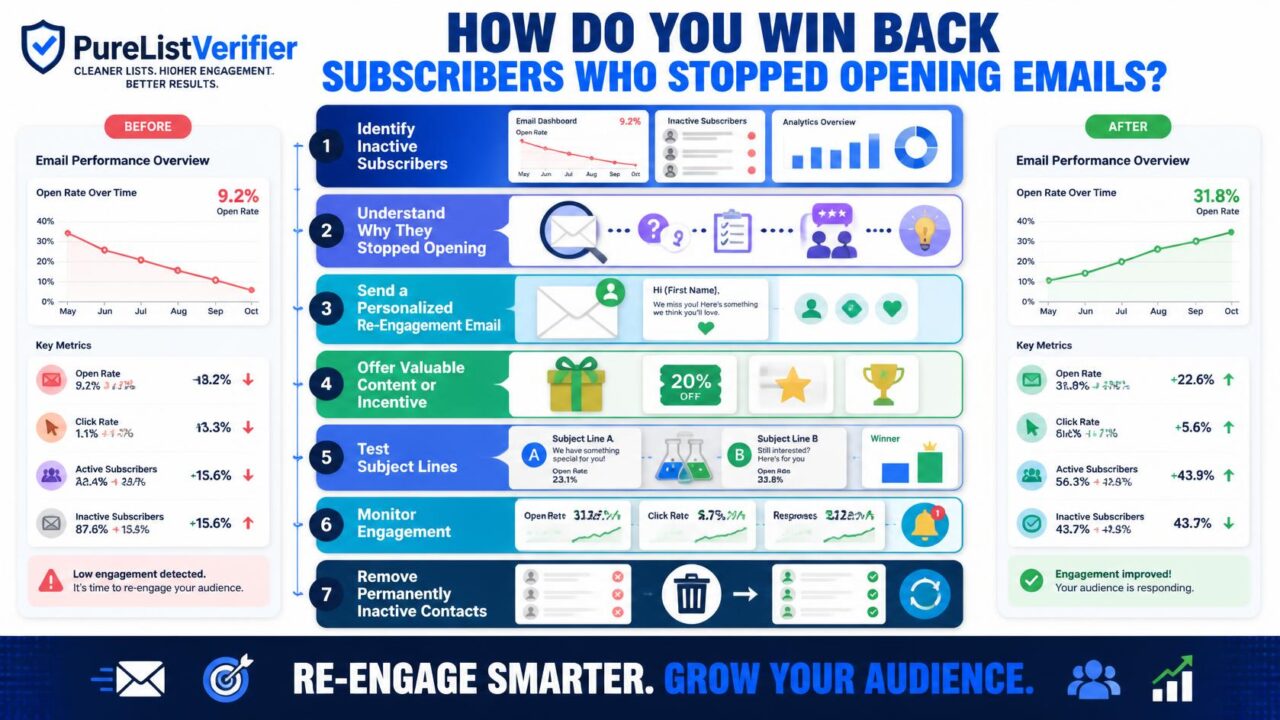
Quick answer: to win back subscribers who stopped opening your emails, send a short, direct re-engagement sequence, usually two or three emails over a couple of weeks, asking plainly if they still want to hear from you, before removing anyone who doesn’t respond. Most re-engagement campaigns recover only a modest share of inactive subscribers, but that’s the point: the goal isn’t rescuing everyone, it’s separating people worth keeping from dead weight that’s quietly dragging down your engagement rate and, over time, your deliverability.
Why inactive subscribers are a real problem, not just a vanity metric
Mailbox providers like Gmail and Outlook track engagement, opens, clicks, and how often recipients delete without reading, as a signal of whether your mail is actually wanted. A large segment of subscribers who never open anything doesn’t just sit there harmlessly, it drags down your overall engagement rate, which providers read as a sign your mail may not be worth prioritizing for anyone, including the subscribers who are genuinely engaged. This is the same underlying reputation mechanism covered in why emails bounce, engagement and deliverability aren’t separate problems, they compound each other.
How long before someone counts as “inactive”
There’s no single universal number, but a common working definition is no opens or clicks in 90 to 180 days, adjusted for how often you actually send. A weekly newsletter can reasonably call someone inactive after 90 days of silence, while a company that emails monthly might wait closer to six months before drawing that line, since the subscriber has simply had fewer chances to engage in the same window.
What an actual re-engagement sequence looks like
- Email one: a genuine, low-pressure check-in. Acknowledge you’ve noticed they haven’t been opening, and ask directly if they’d like to keep receiving your emails. Keep it short and human, not a hard sales pitch.
- Email two, a week or so later: a clearer nudge. If there’s a specific reason to stay, a resource, an offer, a change they might not know about, this is where it belongs. Still short.
- Email three, the final notice. State plainly that you’ll be removing them from future sends unless they take one small action, clicking a link or replying is usually enough.
- Remove non-responders after the sequence ends. Anyone who doesn’t open or click across all three emails has given you a clear, if passive, answer.
What to actually say
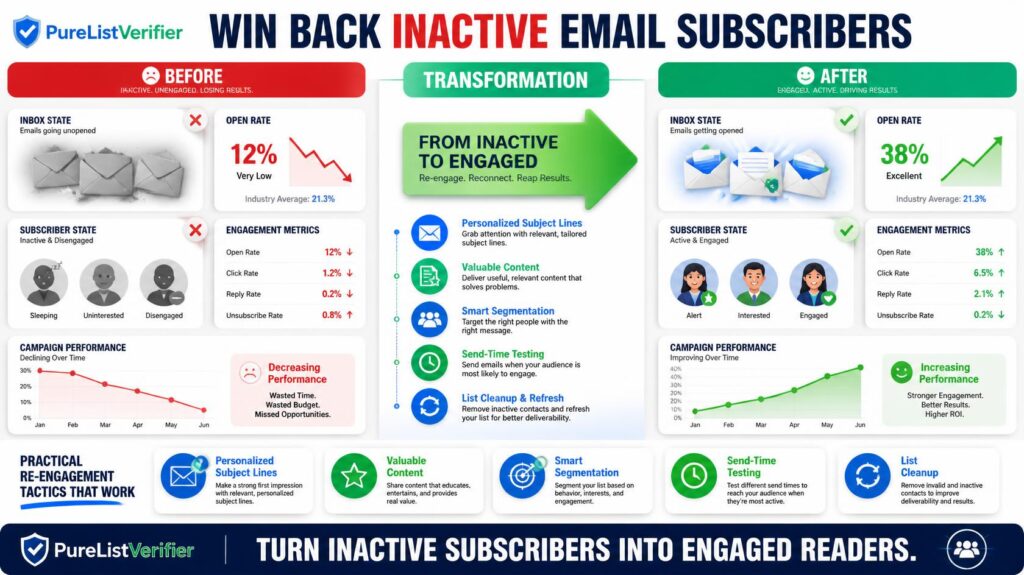
Directness works better than cleverness here. Subject lines like “Do you still want to hear from us?” or “We miss you, but only if you want us back” tend to outperform vague, generic re-engagement subject lines, because they name the actual situation rather than pretending it’s a normal promotional email. The body should ask for one clear action, not multiple, the same single-clear-next-step principle that applies to a good welcome email applies just as much here.
Should you offer an incentive to come back?
It can help, but it’s not required, and it comes with a tradeoff worth knowing: an incentive might recover slightly more people, but some of those people are re-engaging for the discount specifically, not because they actually want your regular content, which means they may go quiet again once the offer’s gone. A plain, honest ask without an incentive tends to surface the subscribers who are genuinely still interested, which is usually the more useful signal for deciding who to keep.
Why removing non-responders is the right call, not a loss
It feels counterintuitive to delete people from a list you worked to build, but a smaller, genuinely engaged list consistently outperforms a larger one padded with silent addresses. Removing confirmed non-responders after a fair re-engagement attempt improves your open and click rates, which in turn improves how mailbox providers treat your future sends to everyone remaining. This is the same logic behind regularly verifying your list for dead addresses, quality over raw size protects deliverability for the subscribers who actually matter.
How this connects back to your overall sender reputation over time
It’s worth zooming out on why any of this matters beyond a single campaign’s numbers. Mailbox providers build a picture of your sending behavior over months, not single sends, and a list that consistently carries a large, unaddressed inactive segment keeps dragging down that longer-term picture even between individual re-engagement efforts. Running this process regularly, rather than as an occasional one-off, is what actually moves the needle on your standing with Gmail, Outlook, and Yahoo over time, a single successful win-back campaign helps, but a sustained habit of removing genuinely unreachable and disengaged contacts is what compounds into meaningfully better inbox placement across everything you send afterward.
How re-engagement campaign performance actually gets measured
It’s easy to judge a win-back sequence purely by how many people click “yes, keep me subscribed,” but that’s only part of the picture. The full value of the campaign includes everyone who quietly re-engages by opening or clicking without formally confirming anything, everyone who unsubscribes cleanly rather than later marking you as spam, and the ongoing improvement to your overall engagement metrics once confirmed non-responders are removed. Measuring success by a single confirmation click rate alone tends to undersell what a well-run re-engagement sequence actually accomplishes for your list’s health going forward.
How often you should run this process
Re-engagement isn’t a one-time project you complete and forget, it’s an ongoing part of list maintenance, since a fresh batch of subscribers crosses your inactivity threshold every month simply through the natural passage of time. Many senders run a rolling win-back sequence automatically, triggered whenever a subscriber crosses the inactivity window you’ve defined, rather than manually pulling a list and sending a one-off campaign every so often. Automating this keeps your list continuously healthy rather than letting a large inactive segment quietly build up between occasional manual cleanups.
Segmenting “inactive” more carefully before you act
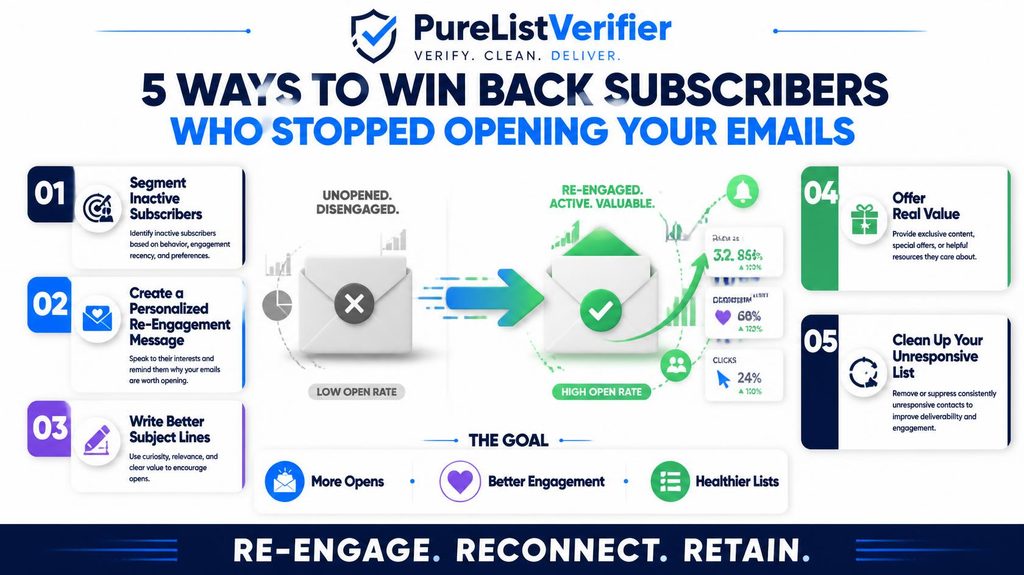
Not every silent subscriber is the same kind of silent. Someone who opened regularly for a year and then suddenly stopped is a very different case from someone who never engaged even once since signing up, the first group is far more likely to respond to a genuine win-back attempt, since something in their situation changed rather than their interest never existing in the first place. Splitting your inactive segment this way before sending a blanket re-engagement campaign lets you tailor the message, referencing what they used to engage with for the first group, while keeping the message simpler and more foundational for subscribers who may never have had a real relationship with your content to begin with.
Why some subscribers go quiet without unsubscribing
Unsubscribing takes a deliberate action, while simply not opening an email takes none at all, which is exactly why silent, disengaged subscribers vastly outnumber those who actively opt out. Some genuinely lost interest but never got around to clicking unsubscribe. Others switched jobs and abandoned the inbox entirely, which is functionally the same problem covered in why emails bounce, an address that still technically exists but nobody checks anymore. And some are still interested in principle but your emails have simply stopped standing out in an increasingly crowded inbox. A win-back sequence can only meaningfully help the third group, which is part of why response rates to these campaigns are modest rather than dramatic.
What to do with subscribers who never had a valid address in the first place
Before investing effort in re-engagement content, it’s worth separately checking whether some of your “inactive” subscribers were never actually reachable to begin with, an old typo that made it past signup, or an address that’s since been deactivated entirely. No re-engagement email, however well written, will ever reach an address that no longer exists, so running your inactive segment through a verification check before building an entire win-back campaign around it can meaningfully shrink the list you need to write for, and clarify how many of your “silent” subscribers are actually unreachable rather than simply uninterested.
A realistic expectation to set before you start
Go into a re-engagement campaign expecting a modest recovery rate, not a dramatic one, most inactive segments won’t rejoin in large numbers no matter how well the emails are written, and that’s a normal, expected outcome rather than a sign the campaign failed. The actual win here is dual: a small number of genuinely reactivated subscribers on one hand, and a clean, honest signal on who to remove on the other. Both outcomes improve your list’s health, even though only one of them looks like a traditional marketing win.
Frequently asked questions
How long should you wait before calling a subscriber inactive?
A common range is 90 to 180 days without an open or click, adjusted based on how frequently you actually send to that subscriber.
What should a re-engagement email actually say?
Be direct: acknowledge they haven’t been opening your emails and ask plainly if they’d like to keep receiving them, with one clear action to confirm, rather than a generic promotional message.
Should you remove subscribers who never respond to a win-back attempt?
Yes. After a fair re-engagement sequence, continuing to email non-responders mostly just drags down your engagement metrics without a realistic chance of winning them back.
Does sending to inactive subscribers hurt deliverability?
Yes, over time. Mailbox providers weigh engagement as a reputation signal, and a large silent segment can lower how favorably your mail is treated even for subscribers who do open and click regularly.
Should you check if inactive addresses still exist before running a win-back campaign?
Yes. Some “inactive” subscribers may have addresses that no longer exist at all, an old typo or a deactivated account, and no re-engagement email will ever reach those regardless of how well it’s written. Verifying first can meaningfully shrink the list you actually need to write for.
Should you treat all inactive subscribers the same way?
No. Someone who engaged for a long time before going quiet is more likely to respond to a win-back attempt than someone who never engaged at all, and tailoring your message to each group tends to perform better than one generic re-engagement email sent to everyone.
Where to start
Pull your list of subscribers with no opens in the last few months and run one honest re-engagement sequence before deciding who stays. And while you’re cleaning house, check that the addresses themselves are still valid, PureListVerifier catches the dead and abandoned addresses that no re-engagement email will ever reach anyway.
