

Quick answer
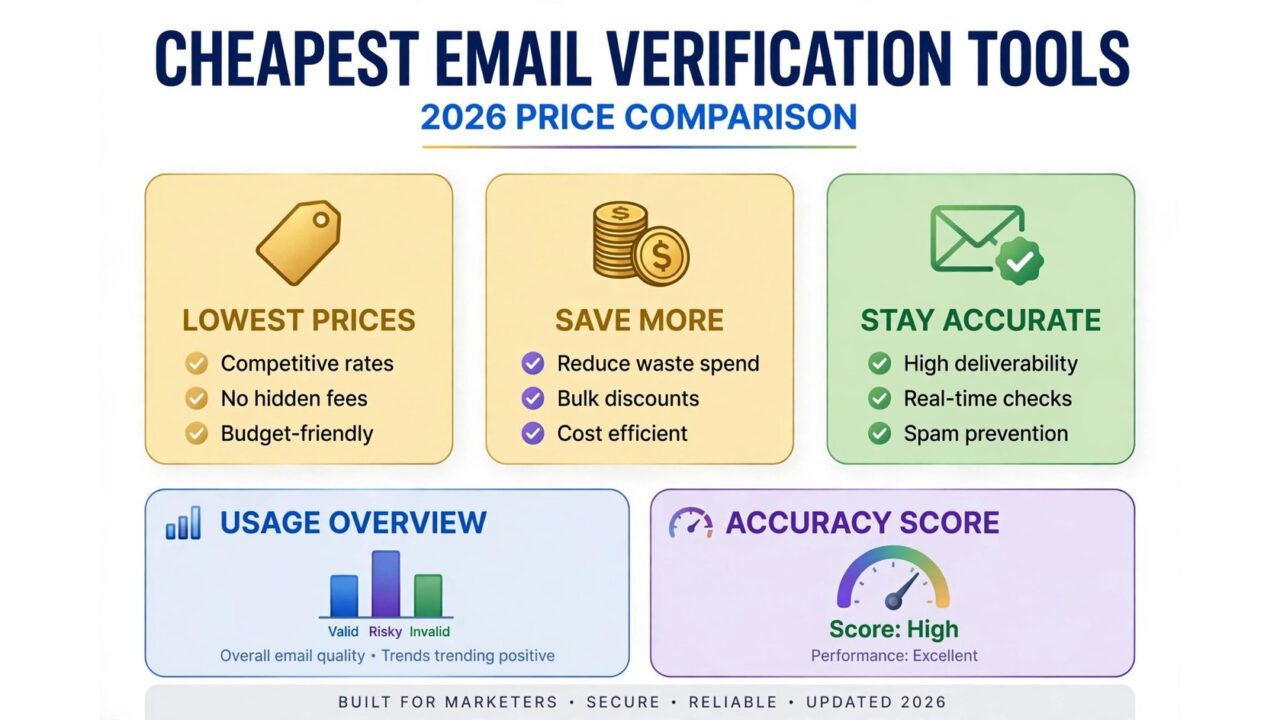
The cheapest email verification tool in 2026 depends on your list size, but pay-as-you-go verifiers now start at roughly $2–$3 per 1,000 emails, while big-name platforms charge $5–$8 for the same thousand. The trick is that “cheapest” only saves you money if accuracy stays high: a $2 tool that misses 10% of bad addresses costs you far more in bounces, spam complaints, and damaged sender reputation than a $4 tool that catches them.
In this guide we compare 7 affordable email verification tools by real per-email prices, free tiers, accuracy signals, and the fine print most pricing pages hide, so you can clean your list without overpaying.
Why does email verification pricing vary so much?
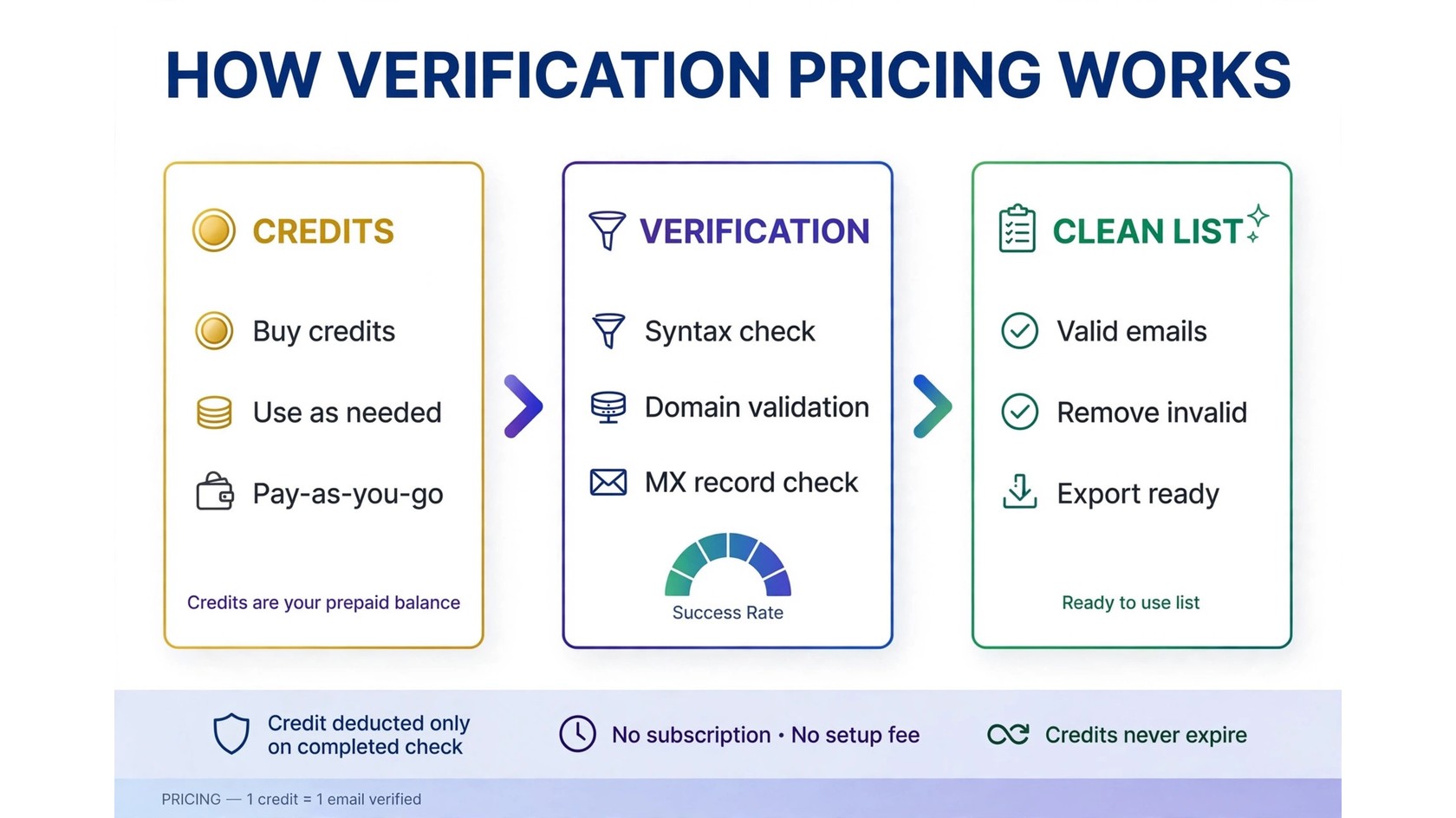
Two tools can both promise “99% accuracy” while one charges $2.40 per thousand emails and the other charges $8. The difference usually comes down to what’s bundled and what’s hidden:
- Credit expiry: some vendors wipe unused credits after 12 months; others let them last forever. For seasonal senders, non-expiring credits are effectively 30–40% cheaper.
- API access: real-time verification at signup forms is included by some tools and a paid add-on at others.
- Extra features: email finding, warmup tools, and deliverability monitoring inflate the price of “verification” plans at premium vendors.
- List-size tiers: per-email cost drops sharply at volume, a tool that’s cheapest at 10,000 emails may not be cheapest at 1 million.
Industry estimates suggest email lists decay by over 20% per year as people change jobs and abandon addresses, which means verification isn’t a one-time purchase. Picking the cheapest email verification tool for your sending pattern matters more than picking the cheapest headline price.
The hidden costs of “free” and ultra-cheap verification
Before chasing the lowest number, understand what cheap can cost you when it’s too cheap:
- Missed spam traps: a verifier that doesn’t detect spam traps can get your domain blocklisted, one blocklisting incident costs more than a year of verification.
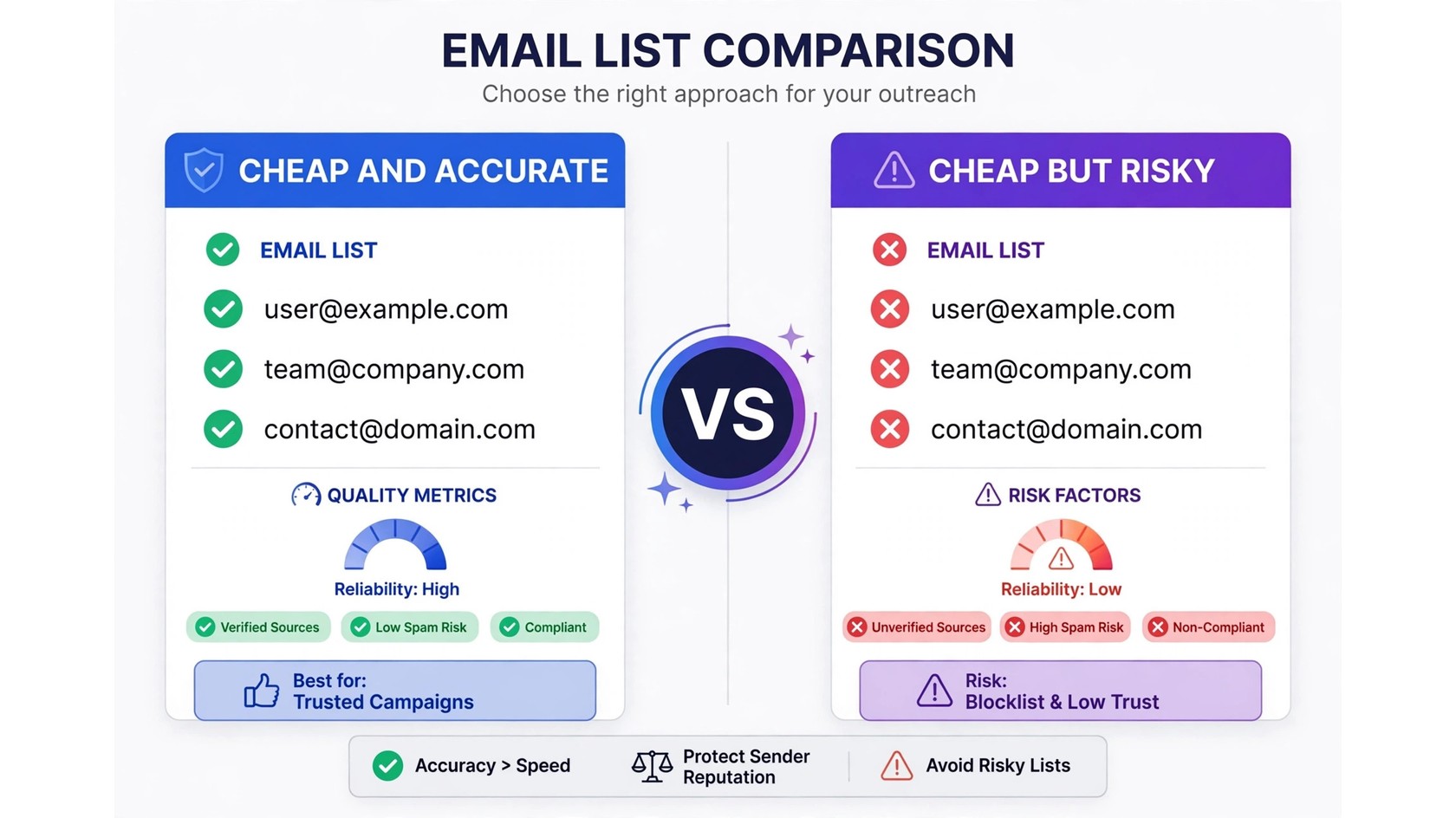
- Catch-all blindness: catch-all domains accept every address, hiding bounces. Cheap tools often mark them “valid” without warning; good ones flag them as risky.
- No re-verification: lists go stale. Tools without affordable re-checks leave you paying full price twice.
The sweet spot is a verifier that’s cheap per accurate result, which is exactly what the comparison below measures.
How we compared the cheapest email verification tools
We standardized every vendor to approximate cost per 1,000 emails using publicly listed 2026 pricing from vendor sites and independent tested comparisons, including Sender.net’s 2026 hands-on comparison and Mailercloud’s 2026 service roundup. We weighted five factors: headline price, credit expiry, free-tier generosity, accuracy signals (independent tests and user reviews), and whether API access costs extra. Prices change, always confirm on the official pricing page before buying.
The 7 cheapest email verification tools compared (2026)
| Tool | ~Cost per 1,000 emails | Free tier | Credits expire? | Best for |
|---|---|---|---|---|
| PureListVerifier | Affordable plans (see pricing) | Available | Check plan terms | Teams wanting simple, dependable verification |
| EmailListVerify | ~$2.40 | 100 credits | Varies by plan | High-speed bulk lists on a budget |
| MillionVerifier | ~$2.90 | 1,000 credits | No (pay-as-you-go) | Lowest price at extreme scale |
| DeBounce | ~$3–$4 | Available | Varies by plan | Startups watching every dollar |
| Bouncer | ~$4.50–$8 | 100 credits | Never (pay-as-you-go) | Accuracy-first buyers |
| Emailable | ~$5 | 250 credits | Never | Ease of use + generous free tier |
| ZeroBounce | ~$6.40 | 100 credits | 12–24 months | Bundled deliverability extras |
Mini-reviews: what each cheap verifier does well
1. PureListVerifier, simple and dependable
PureListVerifier is built around one idea: check addresses, flag invalid or risky contacts, and hand you a cleaner list before you send. It uses a simple credit system, handles bulk lists, and keeps the workflow focused instead of burying verification inside a bloated marketing suite. For teams that want an affordable verifier without a learning curve, it’s a natural starting point. Curious what it can do? Explore PureListVerifier’s features.
2. EmailListVerify, the price fighter
At roughly $2.40 per 1,000 emails, EmailListVerify is the cheapest email verification tool on headline price, advertising 100k+ verifications per hour and a 100-credit free tier. The trade-off: fewer bundled extras than premium rivals, and support responsiveness gets mixed reviews. Best when your priority is raw throughput on huge lists and you’ll handle deliverability monitoring elsewhere.
3. MillionVerifier, cheapest at extreme scale
MillionVerifier’s pricing is tuned for millions of addresses, and its 1,000-credit free tier is among the most generous in the industry, enough to properly test accuracy on a real segment of your list. The interface is utilitarian rather than beautiful, but at this price point, that’s a fair trade for high-volume senders.
4. DeBounce, startup-friendly pricing
DeBounce positions itself for startups with low entry pricing and a clean, modern interface. It covers the essentials, syntax, domain, MX, disposable detection, without enterprise bloat. A sensible pick when budget is the primary constraint and your lists are modest in size.
5. Bouncer, accuracy-first, still affordable
Bouncer costs more per thousand than the budget options, but its pay-as-you-go credits never expire and independent tests consistently rank its accuracy near the top. For seasonal senders who verify in bursts a few times a year, non-expiring credits make Bouncer cheaper in practice than a “cheaper” tool whose credits vanish.
6. Emailable, easiest to use
Emailable’s 250 free credits, single credit type across bulk/API/widget verification, and genuinely simple UX make it a favorite for teams that verify occasionally and hate pricing mazes. Slightly pricier per thousand, but the free tier and no-expiry credits soften that.
7. ZeroBounce, the premium bundle
ZeroBounce is the priciest tool on this list, but the fee bundles email finding, warmup tools, DMARC monitoring, and 45+ integrations. It’s only “cheap” if you’d buy those extras anyway. If you just need verification without the bundle, a focused tool costs far less, see PureListVerifier’s pricing.
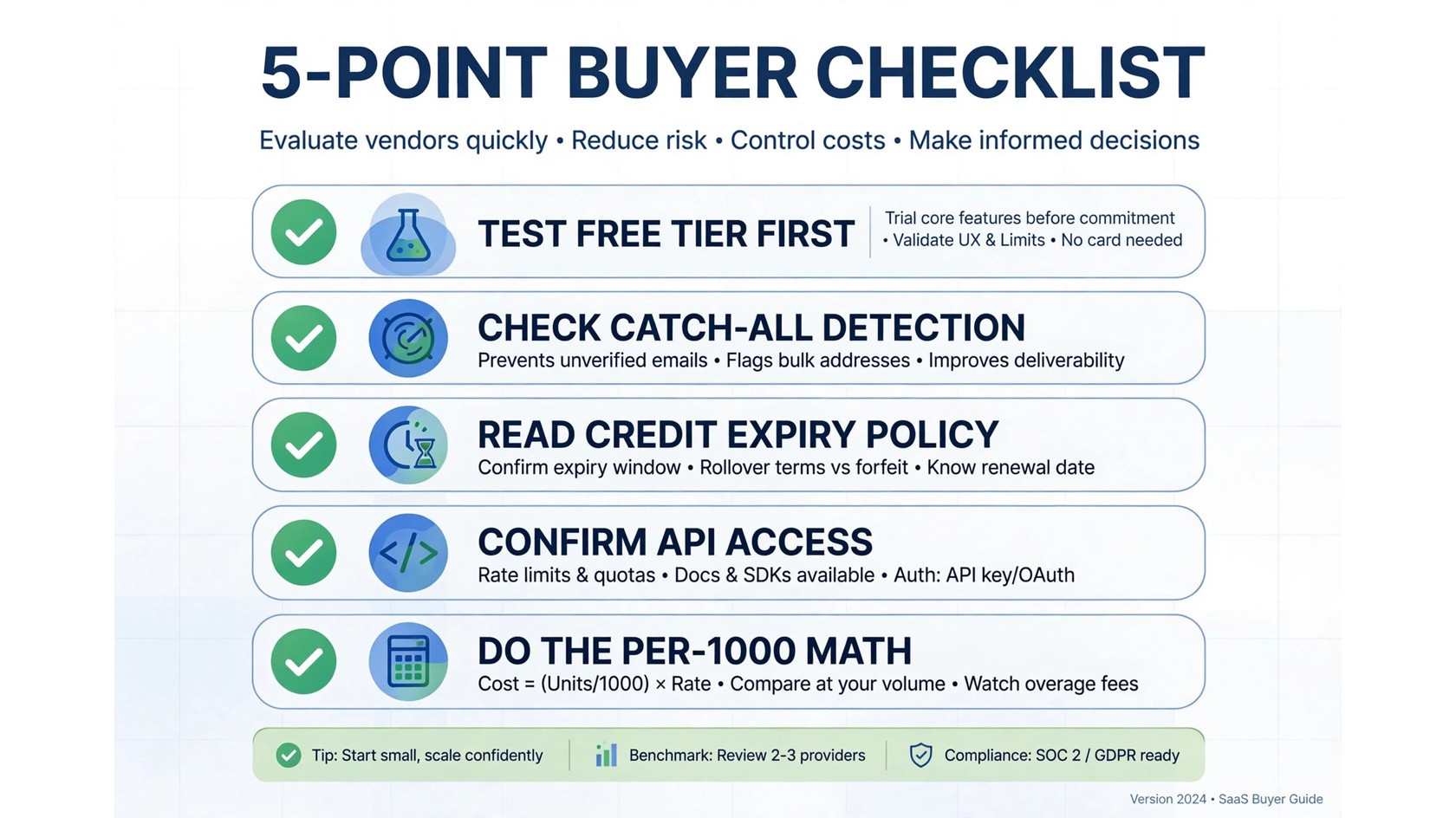
How to choose the right cheap email verifier: 6-point checklist
- Test with the free tier first. Run the same 500-address sample through two tools and compare catch rates on known-bad addresses.
- Check what “invalid” includes. Disposable, catch-all, spam-trap, role-based, and syntax detection should all be standard, ask specifically about catch-all handling.
- Read the credit expiry policy. Non-expiring credits win for seasonal or infrequent senders.
- Confirm API access terms. If you collect emails on signup forms, real-time API verification pays for itself by blocking bad addresses at the source.
- Do the per-1,000 math at YOUR volume. Tier breaks change the ranking, recompute for your actual list size.
- Check re-verification cost. Lists decay; make sure cleaning the same list again in 6 months doesn’t cost full price.
Verification is only half the battle. Pair it with proper list hygiene from the start, using double opt-in on your signup forms keeps bad addresses off your list in the first place, and re-verifying every few months catches the ones that go stale later.
When “cheap” becomes expensive: a warning
The cheapest email verification tool is not the one with the lowest sticker price, it’s the one with the lowest cost per genuinely clean email. A $2 tool with 90% accuracy leaves 100 bad addresses per 1,000; at typical bounce penalties (damaged sender reputation, Gmail throttling, blocklist risk), those 100 addresses can cost you the entire campaign. Always validate accuracy claims with a free-tier test on your own data before migrating a production list.
Real-world math: what verification actually saves you
Put numbers on it. Say you send to 50,000 addresses monthly through an ESP charging $1 per 1,000 emails, and 8% of your list is bad (close to the industry average). That’s 4,000 wasted sends, $4/month in direct ESP fees alone. But the real cost is deliverability: mailbox providers throttle senders with bounce rates above 2%, so those 4,000 bounces can push your legitimate emails to spam for the other 46,000 recipients. Verifying the list at ~$3 per 1,000 ($150 one-time) versus losing even 5% of inbox placement on 46,000 emails makes verification one of the highest-ROI line items in email marketing.
This is also why “free” manual methods, like pinging mailboxes yourself, don’t scale: they’re slow, unreliable against catch-alls, and can get your IP flagged. A proper email verification API checking addresses at signup is the cheapest long-term defense.
FAQs
What is the cheapest email verification tool?
As of 2026, the cheapest email verification tools charge roughly $2–$3 per 1,000 emails on pay-as-you-go plans, with EmailListVerify and MillionVerifier leading on headline price. PureListVerifier offers affordable plans with a simple credit system, check the official pricing page for current rates.
Is there a completely free email verifier?
Most tools offer free tiers (typically 100–1,000 credits) rather than unlimited free verification. MillionVerifier’s 1,000 free credits and Emailable’s 250 credits are among the most generous for testing accuracy before you pay.
How much does email verification cost per 1,000 emails?
Budget tools: $2–$4 per 1,000. Mid-range: $5–$8 per 1,000. Enterprise bundles: $8+. Always compare per-1,000 pricing at your volume, and check whether credits expire.
Are cheap email verifiers accurate?
Price and accuracy aren’t strictly linked, several budget tools score 97–99% in independent tests. The risk with ultra-cheap tools is usually weaker catch-all and spam-trap detection, so test those categories specifically with the free tier.
Do verification credits expire?
It depends on the vendor. Bouncer, Emailable, and MillionVerifier offer non-expiring credits on pay-as-you-go plans, while others expire credits after 12–24 months. For seasonal senders, non-expiring credits are effectively much cheaper.
Can I verify emails without paying anything?
Yes, for small volumes. Use a tool’s free tier (100–1,000 credits), enough to test accuracy and clean a small list. For ongoing sending, a paid plan quickly pays for itself in avoided bounces and protected deliverability.
What’s the difference between email verification and email validation?
The terms overlap, but validation usually means basic technical checks (syntax, domain/MX records) while verification goes deeper, mailbox existence checks plus risky-address detection (disposable, catch-all, spam traps). That distinction matters when you’re comparing tools.
How often should I verify my email list?
Verify new signups in real time via API, re-verify your full list every 3–6 months (lists decay fast), and always verify before any major campaign or after switching email platforms.
The bottom line
The cheapest email verification tool is the one with the lowest true cost per verified email, factoring in accuracy, credit expiry, and free-tier value. Start with free tiers, run the same sample list through two contenders, and let the catch rates decide. Ready to test? Try PureListVerifier and see how many risky addresses are hiding in your list.
