

Quick answer
Looking for a bouncer alternative? Bouncer is one of the most accurate email verifiers on the market, with pay-as-you-go credits that never expire — but at roughly $4.50–$8 per 1,000 emails, it sits above the budget tier. The good news is that several alternatives now match its accuracy while charging less per thousand, offering generous free tiers, or bundling extras that fit your workflow better.
In this guide we compare 7 Bouncer alternatives by approximate per-email pricing, free tiers, credit expiry, accuracy signals, and how painless migration is — so you can switch without risking your deliverability.
Why switch from Bouncer? Where it shines — and where it costs you
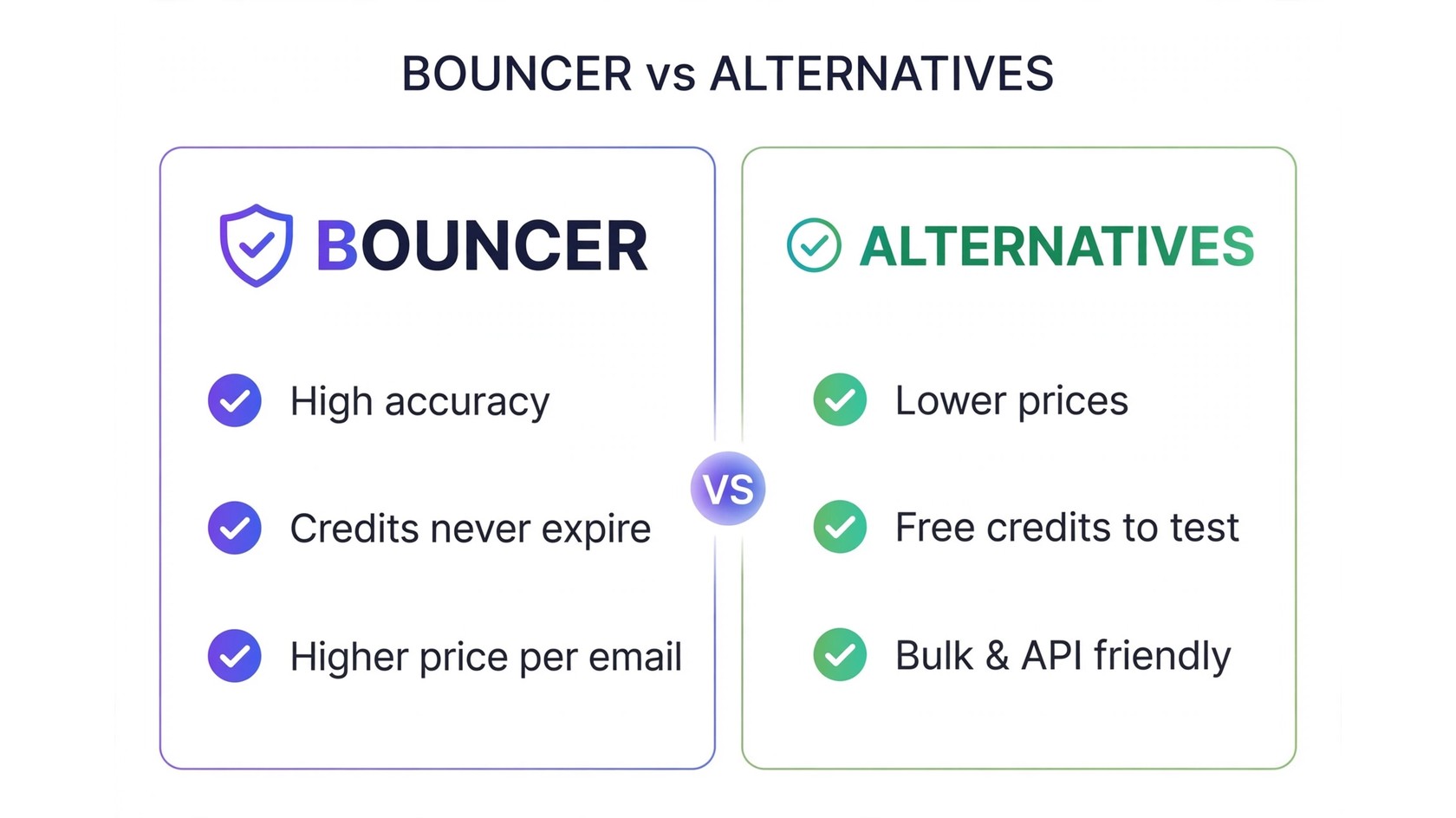
Bouncer earned its reputation by being accuracy-first: independent tests consistently rank it near the top, and its pay-as-you-go credits never expire, which makes it genuinely cheap in practice for seasonal senders who verify in bursts. If you verify a list once every six months, non-expiring credits beat a “cheaper” tool that wipes your balance every year.
Still, there are solid reasons to look for a bouncer alternative:
- Per-email price: Bouncer’s accuracy-first pricing (~$4.50–$8 per 1,000 emails) is roughly double what some focused verifiers charge. At 500,000+ emails, that gap becomes real money.
- Small free tier: Bouncer gives you 100 free credits — enough to test, but some alternatives hand you 250–1,000 free credits so you can run a meaningful accuracy comparison on your own list before paying.
- Feature fit: if you mainly need bulk verification with a simple API and fast turnaround, you may be paying for polish and extras you never touch.
- Volume discounts: competitors tuned for millions of addresses can undercut Bouncer at extreme scale.
None of this makes Bouncer bad — it just means the best verifier for you depends on volume, frequency, and budget. The comparison below standardizes every option to approximate cost per 1,000 emails so you can see the trade-offs clearly.
What to check before switching to a bouncer alternative
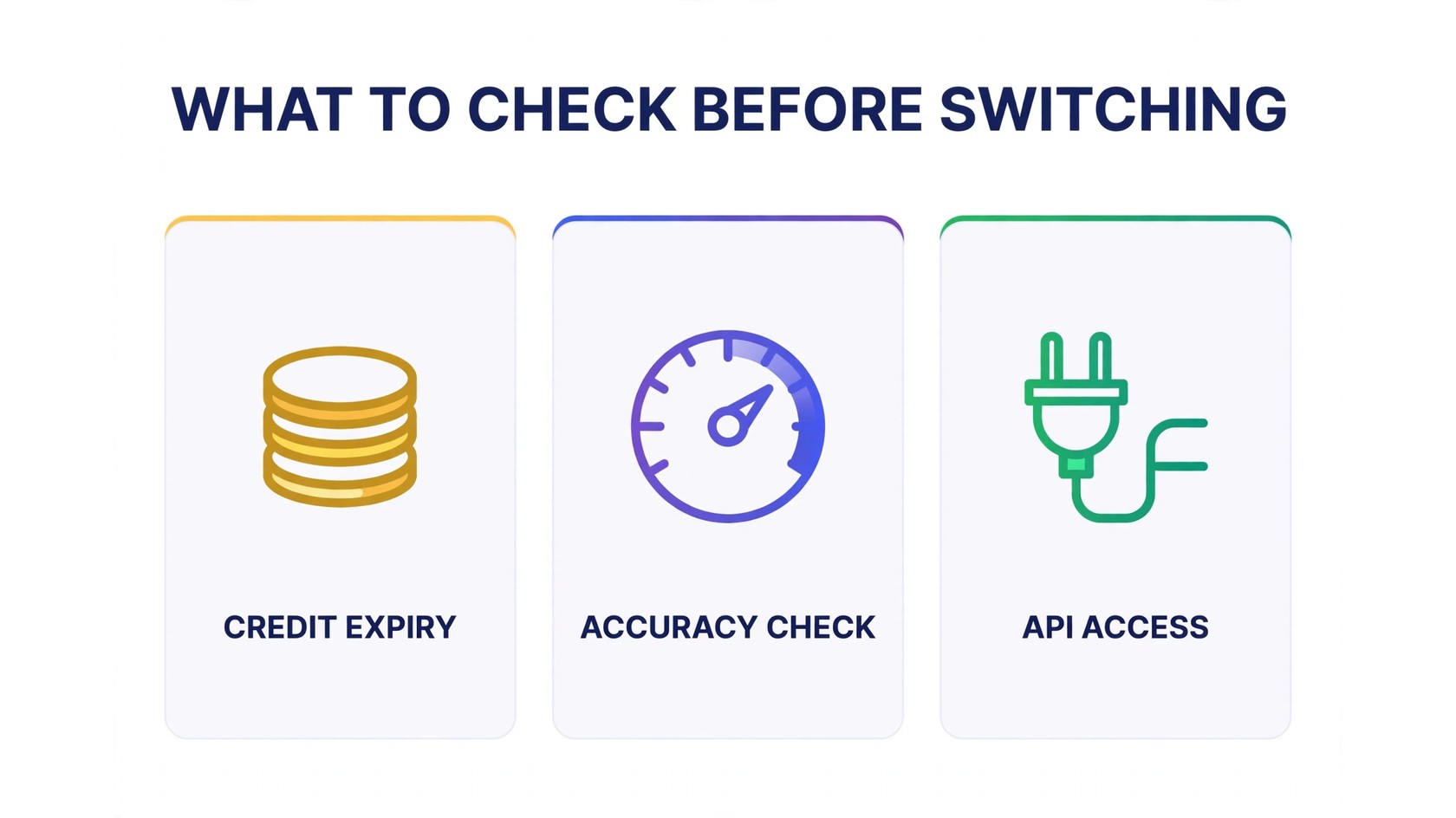
Switching verifiers is only safe if accuracy doesn’t drop with the price. Before you migrate a production list, check these four factors:
- Accuracy signals: look for independent hands-on tests and user reviews that measure catch rates on real lists — not the vendor’s own “99% accuracy” claim. Tools covered by recent tested comparisons include Sender.net’s 2026 email verification comparison and Mailercloud’s 2026 service roundup.
- Credit expiry: Bouncer’s never-expiring credits are a genuine advantage. If you verify seasonally, an alternative whose credits expire after 12–24 months can cost you more in practice despite a lower sticker price.
- Catch-all and spam-trap handling: catch-all domains accept every address and hide bounces. Ask specifically whether the alternative flags catch-alls as risky and detects spam traps — this is where budget tools differ most.
- API access: if you collect emails on signup forms, confirm real-time API verification is included (not a paid add-on) so you can block bad addresses at the source.
Rule of thumb: run the same 500-address sample — including some known-bad addresses — through Bouncer and two alternatives before committing. Catch-rate differences on your own data beat any marketing claim.
How we compared these Bouncer alternatives
We standardized every vendor to approximate cost per 1,000 emails using publicly listed 2026 pricing, and weighted five factors: headline price, credit expiry, free-tier generosity, accuracy signals (independent tests and user reviews), and API access terms. Prices change frequently — treat every figure below as an approximate range and confirm on the official pricing page before buying.
The 7 best Bouncer alternatives compared (2026)
| Alternative | ~Cost per 1,000 emails | Free tier | Credits expire? | Best for |
|---|---|---|---|---|
| PureListVerifier | Affordable plans (see pricing) | Available | Check plan terms | Simple, dependable verification without bloat |
| NeverBounce | ~$6–$8 | 1,000 credits | Varies by plan | Teams invested in deliverability tooling |
| ZeroBounce | ~$6.40 | 100 credits | 12–24 months | Bundled extras (email finding, warmup, monitoring) |
| Emailable | ~$5 | 250 credits | Never | Ease of use and a generous free tier |
| DeBounce | ~$3–$4 | Available | Varies by plan | Startups watching every dollar |
| MillionVerifier | ~$2.90 | 1,000 credits | No (pay-as-you-go) | Lowest price at extreme scale |
| EmailListVerify | ~$2.40 | 100 credits | Varies by plan | High-speed bulk lists on a budget |
Two things stand out: the cheapest options (EmailListVerify, MillionVerifier) cut Bouncer’s per-email cost roughly in half, and mid-tier picks like Emailable match Bouncer’s non-expiring-credit advantage while costing less. For a wider field of options, see our full roundup of the best email verification tools.
Mini-reviews: what each bouncer alternative does well
1. PureListVerifier — simple and dependable
PureListVerifier is built around one idea: check addresses, flag invalid or risky contacts, and hand you a cleaner list before you send. It uses a simple credit system, handles bulk lists, and keeps the workflow focused instead of burying verification inside a bloated marketing suite. For teams that want an affordable bouncer alternative without a learning curve, it’s a natural starting point. Curious what it covers? Explore PureListVerifier’s features or check the pricing page for current plans.
2. NeverBounce — the deliverability ecosystem pick
NeverBounce is often priced near Bouncer (~$6–$8 per 1,000) but differentiates with a large integration library and deliverability tooling, plus a generous 1,000-credit free tier for testing. It’s a reasonable bouncer alternative if you want verification plugged into an ESP, CRM, or signup flow with minimal setup. See how it stacks up head-to-head in our NeverBounce alternative guide.
3. ZeroBounce — the premium bundle
ZeroBounce sits in the same premium bracket as Bouncer, but the fee bundles email finding, warmup tools, DMARC monitoring, and 45+ integrations. If you were already shopping for those extras, it’s competitive; if you just need verification, a focused tool costs far less. Read our ZeroBounce alternative comparison if you’re weighing the bundle versus standalone verification.
4. Emailable — the never-expiring middle ground
Emailable is arguably the closest like-for-like bouncer alternative: its pay-as-you-go credits never expire, its 250 free credits beat Bouncer’s 100, and its genuinely simple UX makes switching painless. At roughly ~$5 per 1,000 emails it undercuts Bouncer while keeping the non-expiring-credit model that seasonal senders love.
5. DeBounce — the startup pick
DeBounce positions itself for startups with low entry pricing (~$3–$4 per 1,000) and a clean, modern interface. It covers the essentials — syntax, domain, MX, disposable detection — without enterprise bloat. A sensible bouncer alternative when budget is the primary constraint and your lists are modest in size.
6. MillionVerifier — cheapest at extreme scale
MillionVerifier’s pricing is tuned for millions of addresses (~$2.90 per 1,000), and its 1,000-credit free tier is among the most generous in the industry — enough to properly test accuracy on a real segment of your list. The interface is utilitarian rather than beautiful, but high-volume senders get serious savings here.
7. EmailListVerify — the price fighter
At roughly $2.40 per 1,000 emails, EmailListVerify is the cheapest bouncer alternative on headline price, advertising 100k+ verifications per hour. The trade-off: fewer bundled extras and mixed reviews on support. Best when your priority is raw throughput on huge lists. We compared it in detail against a focused verifier in our PureListVerifier vs EmailListVerify breakdown.
How to switch from Bouncer without risk: 5-step migration
Switching verifiers doesn’t have to endanger your deliverability. Follow this sequence:
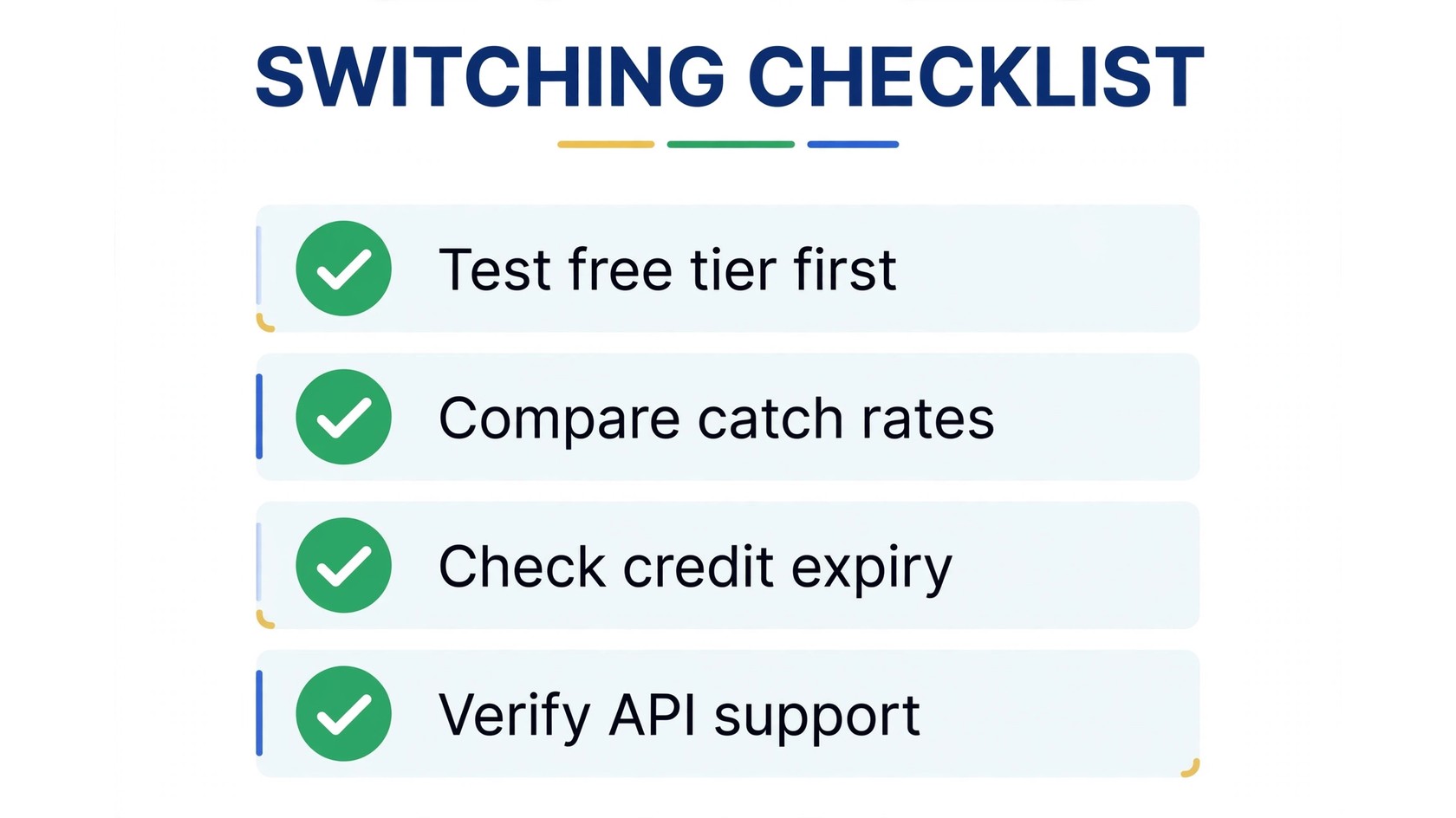
- Start with the free tier. Every alternative above offers free credits. Use them on a test segment — not your production list.
- Run a head-to-head accuracy test. Send the same 500–1,000 addresses (including known-bad ones you seeded yourself) through Bouncer and the alternative. Compare catch rates on invalid, disposable, and catch-all addresses specifically.
- Check the credit model. If Bouncer’s never-expiring credits fit your seasonal pattern, only switch to an alternative with matching terms — or confirm the price gap justifies the change.
- Verify the API and export formats. If Bouncer feeds your signup forms or ESP automatically, confirm the replacement offers a real-time email verification API and exports your ESP accepts.
- Migrate in parallel, then cut over. Run both tools on one campaign cycle, compare results, and only move the full list once the alternative’s accuracy matches on your own data.
The biggest migration mistake is switching based on price alone without testing accuracy first. A verifier that costs half as much but misses 5% more bad addresses will cost you far more in bounces and spam-placement damage.
FAQs
Is there a cheaper bouncer alternative that is just as accurate?
Yes — several. Budget-focused verifiers now charge roughly half of Bouncer’s ~$4.50–$8 per 1,000 emails, and independent tested comparisons show top budget tools scoring in the high 90s on accuracy. The safest move is to run the same sample list through Bouncer and two alternatives and compare catch rates on your own data before migrating.
Why is Bouncer so expensive compared to alternatives?
Bouncer prices for its accuracy-first positioning, fast processing, and a credit system where pay-as-you-go credits never expire. Alternatives cut costs by targeting specific segments — extreme bulk volume, startups, or focused verification without premium extras. Prices change often, so always confirm on the official pricing page.
Do Bouncer credits expire?
No — Bouncer’s pay-as-you-go credits never expire, which is one of its biggest advantages for seasonal senders. If that matters to you, prioritize alternatives with matching terms: Emailable and MillionVerifier also offer non-expiring credits on pay-as-you-go plans, while others expire credits after 12–24 months.
Can I test a bouncer alternative for free?
Yes. MillionVerifier and NeverBounce offer 1,000 free credits, Emailable offers 250, and most others offer 100 or more. That’s enough to run a proper head-to-head accuracy test against Bouncer on a sample of your list before spending anything.
How do I migrate my list from Bouncer to another tool?
Export your list (or keep it in place if you verify via API), test the alternative’s free tier on a seeded sample, confirm the API and export formats match your workflow, then run both tools in parallel for one campaign cycle before cutting over fully.
Will switching email verifiers hurt my deliverability?
Only if the replacement is less accurate. Deliverability damage comes from bounces and spam complaints caused by bad addresses slipping through — not from changing tools. Test catch rates on your own data first, and there’s no deliverability risk in switching.
Which bouncer alternative is best for small lists?
For small or occasional lists, prioritize generous free tiers and non-expiring credits over headline per-email price. Emailable’s 250 free credits and never-expiring model fit occasional senders well, and PureListVerifier’s plans are worth checking if you want a simple focused verifier.
The bottom line
The best bouncer alternative depends on what you valued in Bouncer. If it was the never-expiring credits, Emailable keeps that model for less. If it was raw accuracy, budget tools now score in the high 90s in independent tests for roughly half the price. And if it was simplicity, a focused verifier costs far less than a premium bundle you’ll never fully use.
Don’t switch on price alone — run the free-tier head-to-head test on your own list first, then let the catch rates decide. Ready to test? Try PureListVerifier and see how many risky addresses are hiding in your list.
