

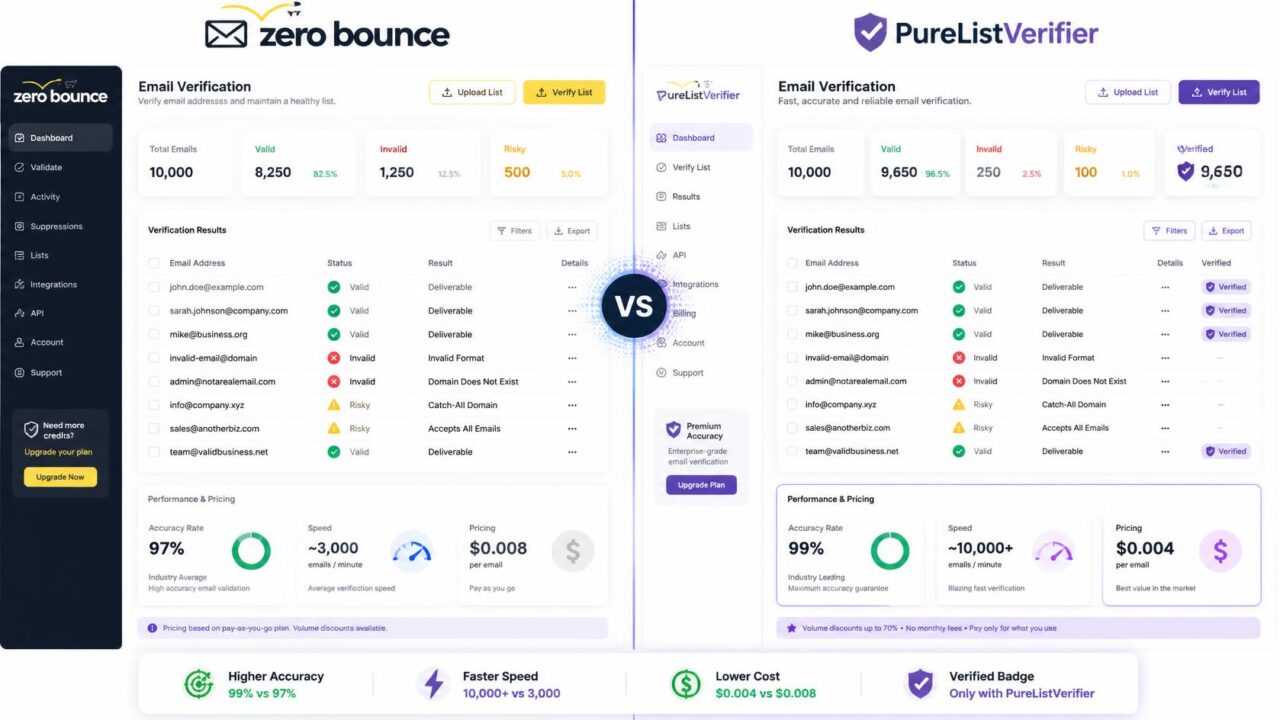
Quick answer: if you’re looking for a ZeroBounce alternative, the main thing to know is that ZeroBounce runs a genuinely useful free tier, 100 credits a month, ongoing, with no card required, while paid usage jumps to $99 a month minimum. PureListVerifier skips the free tier entirely but offers lower, more predictable monthly pricing starting at $18 for teams who verify regularly rather than occasionally. Which is the better fit depends on whether you want to test for free first or you already know you’ll be checking lists every month.
The short version
| PureListVerifier | ZeroBounce | |
| Pricing model | Monthly subscription only | Free tier + paid subscription |
| Starting price | $18/month (50,000 credits) | Free (100 credits/mo) or $99/month (10,000 credits) |
| Free tier | Not confirmed on current pricing page | 100 credits every month, ongoing, no card required |
| Published accuracy rate | Not published | 99.6% (self-reported) |
| Charges for unknown results? | Not specified | No, unknown results are free |
| Extra features included | Verification workspace with usage tracking | Free inbox placement test, blacklist monitor |
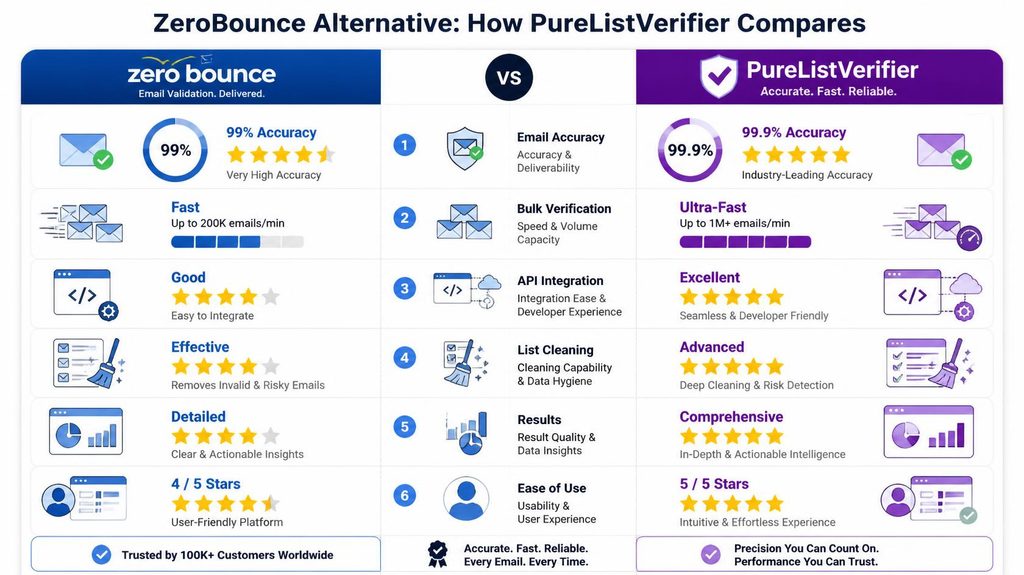
ZeroBounce’s free tier is the real differentiator
ZeroBounce offers something unusual in this space: 100 free validation credits every single month, ongoing, not just as a one-time trial. For a very small list, or for testing whether verification is worth adopting at all before spending anything, this is a genuinely useful, low-risk starting point that few competitors match. PureListVerifier’s current pricing page doesn’t show an equivalent ongoing free tier, so trying it means committing to at least the $18 plan.
Where the pricing actually diverges
Past the free tier, ZeroBounce’s paid plan, ZeroBounce ONE, starts at $99 a month for a minimum of 10,000 credits. PureListVerifier’s $18-a-month entry plan covers 50,000 credits, a meaningfully lower cost per address at that volume, though the comparison isn’t perfectly apples-to-apples since ZeroBounce’s paid tier bundles in extras like inbox placement testing and blacklist monitoring that aren’t part of a basic per-address price. See our fuller breakdown of what actually drives email verification pricing if you want to compare structures more broadly.
A detail worth knowing: unknown results are free
ZeroBounce doesn’t charge for results that come back as “unknown,” a detail that matters more than it might seem. Since some percentage of any list will always land in ambiguous, hard-to-confirm territory, mostly catch-all domains, not being charged for those specific results is a meaningful, practical saving on a large or messy list. It’s worth asking directly whether any alternative you’re considering, including PureListVerifier, handles unknown results the same way before assuming pricing is directly comparable credit-for-credit.
What ZeroBounce bundles in beyond verification
ZeroBounce includes a free inbox placement test and a blacklist monitor alongside its core verification service, tools that some competitors sell separately or don’t offer at all. If you specifically want deliverability monitoring bundled with your verification tool rather than managed separately, this is a real point in ZeroBounce’s favor worth weighing against PureListVerifier’s more narrowly focused workspace.
Who should pick which
- Choose ZeroBounce if: you want to test verification for free before spending anything, your volume is small enough to fit the free tier, or you want inbox placement and blacklist monitoring bundled in.
- Choose PureListVerifier if: you already know you’ll be verifying regularly and want a lower, more predictable monthly cost at meaningful volume, without paying for bundled features you may not use.
See the fuller roundup of every major email verification tool compared if you want to weigh a few more options beyond just these two.
Support and onboarding differences worth weighing
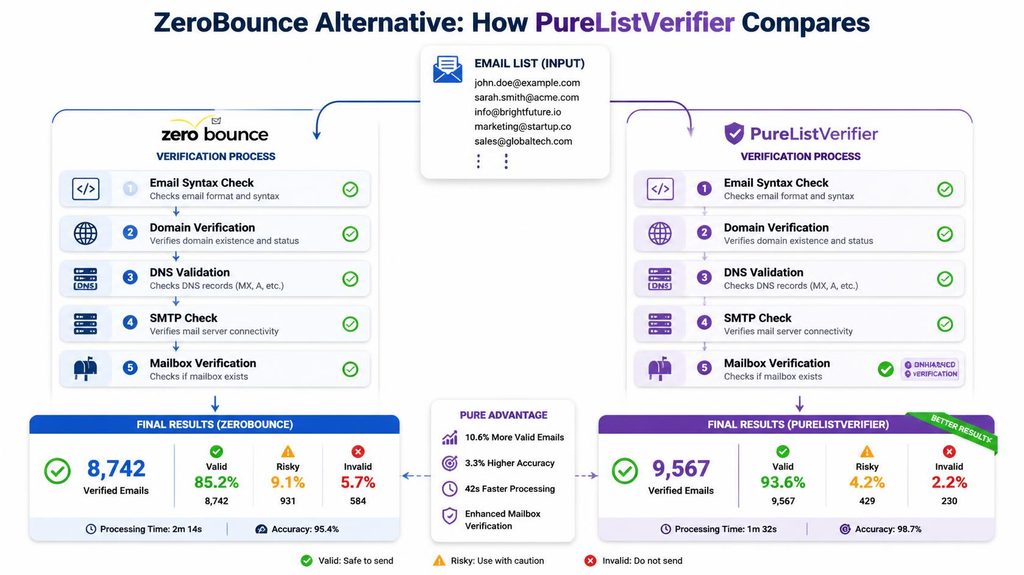
Pricing and accuracy tend to dominate comparisons like this one, but for teams new to email verification altogether, how much guidance a provider offers during setup can matter just as much. A larger, more established tool like ZeroBounce, with a bigger customer base and a longer track record, often has more documentation, community discussion, and third-party integration guides available simply by virtue of scale. A newer or smaller provider may offer more direct, personal support instead, faster individual responses rather than a large self-serve knowledge base. Neither is objectively better, but it’s worth knowing which kind of support experience you’d actually prefer before you’re stuck mid-setup with a question.
Why “accuracy rate” numbers are hard to compare directly across providers
ZeroBounce publishes a 99.6% accuracy claim, and most competing providers publish similarly high numbers, often in the same 97-99% range. These figures are self-reported, calculated using each provider’s own internal methodology and typically their own test datasets, which makes a direct apples-to-apples comparison difficult even when the headline numbers look close. A genuinely useful comparison means testing your own real list against more than one provider and comparing the actual downstream bounce rate you experience when you send, not relying on any single published percentage as the deciding factor.
How the two tools handle catch-all domains
Catch-all domains, mail servers configured to accept mail sent to any address at that domain regardless of whether a specific mailbox exists, are the single biggest source of ambiguity for every email verification provider, not just these two. No verification tool can definitively confirm a catch-all address is real without actually sending mail to it, which most providers deliberately avoid doing on your behalf. ZeroBounce labels these results as “catch-all” and, notably, doesn’t charge for them, treating the ambiguity as its own cost rather than passing it on to you. Confirm directly how any alternative handles this same scenario before assuming your effective cost per verified address will be identical.
Integration and workflow differences worth checking
Beyond price and accuracy, how a tool fits into your actual workflow matters just as much day to day. Check whether your shortlist of alternatives offers a direct integration with the email platform or CRM you already use, a genuine real-time API for verifying addresses at the point of signup rather than only in bulk batches, and reasonable file size limits for bulk uploads if you’re regularly cleaning large lists at once. A tool that’s cheaper per credit but forces you to manually export and re-import files every time can end up costing more in time than it saves in subscription cost.
What to actually test before committing to either one
- Run the same sample list through both, ideally one you already know the real-world outcome for, and compare how each categorizes the same addresses.
- Check how each handles your specific catch-all domains, since this is where results are most likely to diverge between providers.
- Confirm actual pricing at your real monthly volume, not just the advertised starting tier, since costs can scale differently once you’re past an entry-level plan.
- Test the real-time API response speed if you plan to verify at the point of signup rather than only in scheduled bulk batches.
Common mistakes people make comparing verification tools
The most common mistake is comparing headline prices without normalizing for actual volume, a $99-a-month plan covering 10,000 credits and an $18-a-month plan covering 50,000 credits look wildly different until you calculate cost per thousand addresses specifically, at which point the comparison usually flips depending on your real usage pattern. A second common mistake is trusting a self-reported accuracy percentage as if it were independently audited, when in reality every provider calculates that number using its own methodology and test data. And a third is ignoring how a provider handles catch-all or unknown results entirely, since that single policy can meaningfully change your real effective cost on a messy, real-world list far more than the advertised per-credit price suggests on its own.
What happens if you outgrow whichever one you start with
Neither choice here is permanent, and it’s worth knowing upfront that switching later is genuinely low-effort if your needs change. Someone who starts on ZeroBounce’s free tier and eventually needs real monthly volume can move to a paid plan there or export their workflow to a different provider entirely, since verification tools don’t lock in your subscriber data the way an email sending platform does. The reverse is just as easy: a team on a flat monthly subscription that suddenly has a quiet quarter isn’t stuck paying for volume it doesn’t use in the same way a credit-based model would naturally scale down. Treat this decision as a reasonable starting point rather than a permanent commitment either way.
A simple way to decide without overthinking it
If you’re stuck weighing every feature against every other one, a simpler question often settles it faster: are you testing whether verification is worth doing at all, or do you already know you need it every month? The first situation points toward ZeroBounce’s free tier as the lower-risk starting point, since there’s genuinely nothing to lose by testing there first. The second points toward comparing predictable monthly subscription costs, like PureListVerifier’s, against what the same volume would actually cost in ZeroBounce credits, since at that point you’re optimizing for ongoing cost and workflow fit rather than testing a new category of tool for the first time.
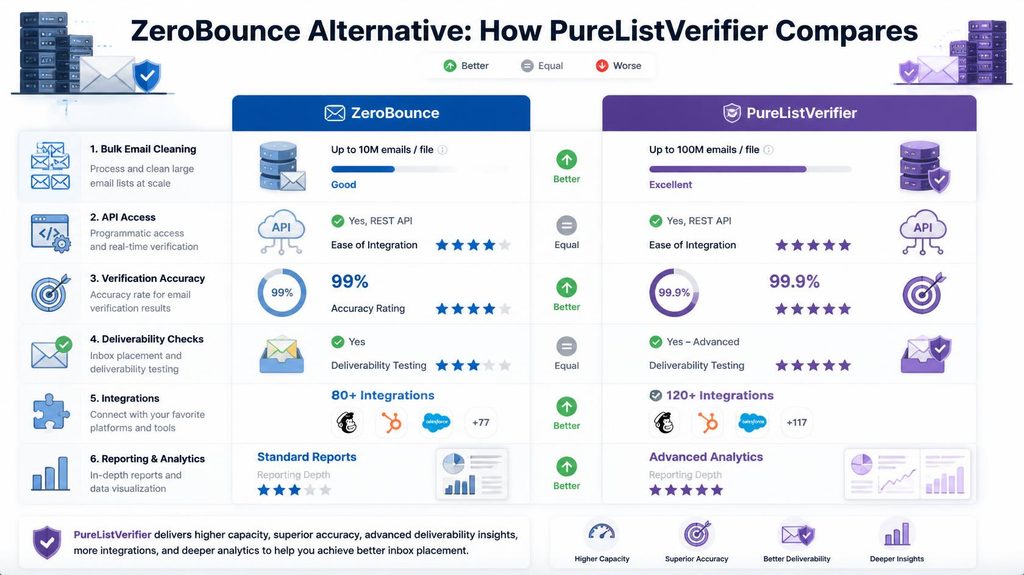
Frequently asked questions
What does ZeroBounce’s free tier actually include?
100 validation credits every month, ongoing, with no card required, plus a free inbox placement test and blacklist monitor.
Is ZeroBounce accurate?
ZeroBounce publishes a 99.6% accuracy claim. Like any verification provider, no tool can guarantee 100%, mainly due to catch-all domains, which is a structural limit of the industry rather than specific to ZeroBounce.
Can you switch away from ZeroBounce easily?
Yes. Verification tools work on a list you upload or connect, they don’t store an ongoing copy of your subscriber relationship, so switching is just a matter of exporting your list and running it through a new tool.
Does ZeroBounce charge for unknown results?
No, results that come back as unknown aren’t charged, which can meaningfully lower the real cost of checking a list with a lot of catch-all or ambiguous domains.
Does PureListVerifier handle catch-all domains differently than ZeroBounce?
Catch-all handling varies by provider and isn’t always publicly detailed in the same way. Confirm directly with either provider how catch-all results are labeled and charged before assuming the two behave identically.
Which is better for a very large list, over a million addresses?
Both are built to handle large bulk lists, so the deciding factor at that scale is usually cost per address at your actual volume plus how well each fits your existing workflow, rather than a difference in raw processing capability.
Where to start
If you want to test the waters for free first, ZeroBounce’s free tier is the lower-risk starting point. If you already verify regularly and want predictable, lower-cost monthly billing at real volume, PureListVerifier’s subscription plans are worth comparing directly against what you’re currently paying.

1 comment