

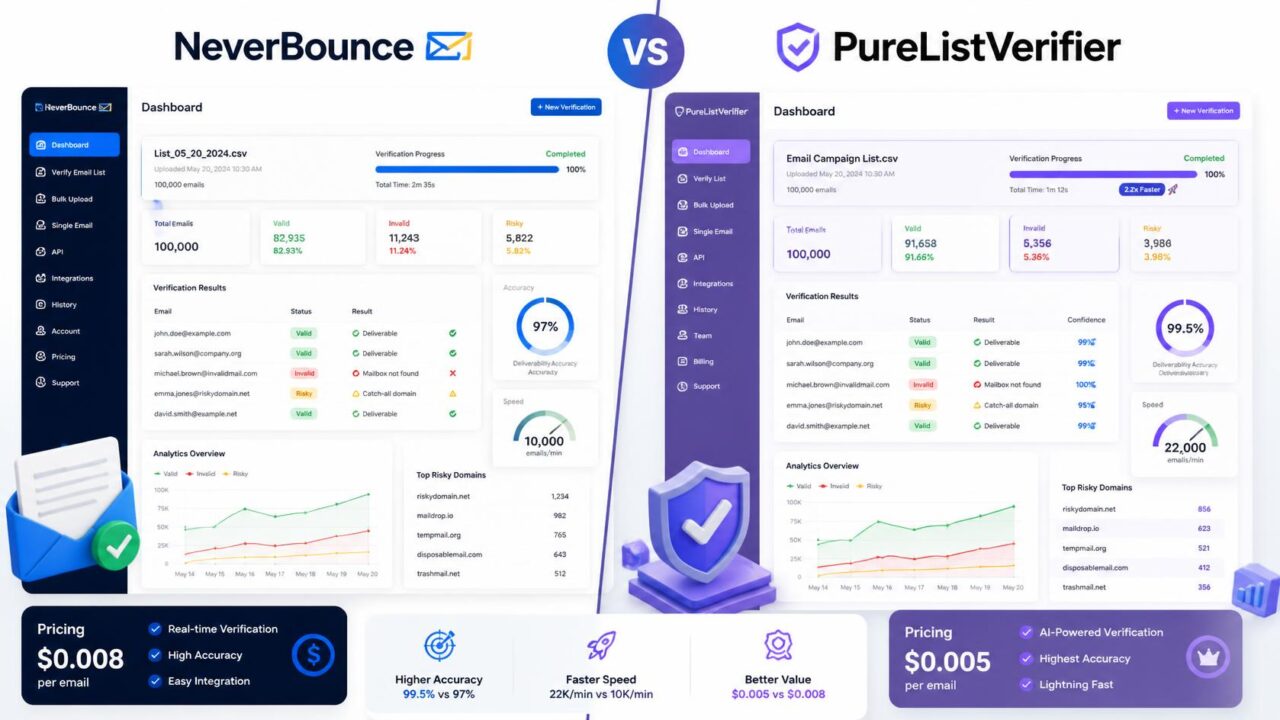
Quick answer: a NeverBounce alternative is worth considering mainly because NeverBounce is now owned by ZoomInfo, which has shifted its focus and pricing toward ZoomInfo’s own enterprise customer base rather than standalone self-serve users. NeverBounce still offers pay-as-you-go credit pricing that drops as you buy more, but PureListVerifier offers a simpler flat monthly subscription without needing to navigate a larger ZoomInfo account structure to get started.
Why people go looking for a NeverBounce alternative
NeverBounce was acquired by ZoomInfo in 2021, and since then it’s increasingly positioned as part of ZoomInfo’s broader go-to-market platform rather than a standalone tool aimed at smaller, independent users. That’s not necessarily a problem if you’re already a ZoomInfo customer, but it’s exactly why smaller teams and solo senders who just want a straightforward email checker, without being pulled into a larger sales conversation, start looking elsewhere.
The short version
| PureListVerifier | NeverBounce | |
| Ownership | Independent | Owned by ZoomInfo (since 2021) |
| Pricing model | Flat monthly subscription | Pay-as-you-go credits, price per credit drops at higher volume |
| Starting price | $18/month (50,000 credits) | Credit-based, priced per verification tier |
| Best fit | Predictable monthly senders | Occasional or highly variable-volume senders |
| Account setup | Standalone signup | Can involve broader ZoomInfo account structure |
How NeverBounce’s pricing actually works
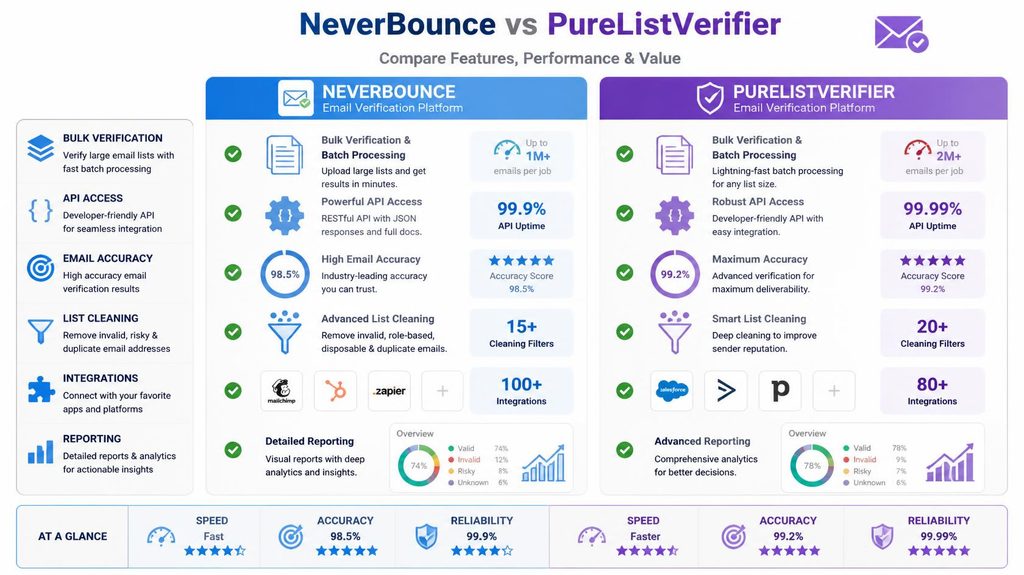
NeverBounce uses a pay-as-you-go credit model, where the price per verification drops as you purchase larger credit packs. This can work well for a sender with irregular volume, a big list to clean once and then nothing for months, since you’re not committing to a recurring subscription you might not fully use. It works less well if you verify smaller amounts consistently every month, since you don’t get the benefit of a lower flat recurring rate that a subscription model like PureListVerifier’s is built around.
The ZoomInfo factor
Since the acquisition, NeverBounce increasingly appears as a feature within ZoomInfo’s broader sales and marketing platform, alongside contact data, intent signals, and outbound tooling, rather than purely as a standalone product page. If you only need email verification and nothing else ZoomInfo offers, this can mean navigating more account setup and sales contact than a purpose-built, standalone verification tool requires. That’s a structural difference in how you access the product, not necessarily a difference in verification quality itself.
Where NeverBounce still makes sense
If your organization already uses ZoomInfo for contact data or sales intelligence, having verification bundled into the same platform genuinely simplifies your stack, one login, one vendor relationship, one invoice, instead of managing a separate standalone tool. For teams in that position, switching away from NeverBounce purely to save on a standalone subscription may not be worth the added vendor complexity.
Where a standalone alternative makes more sense
- You don’t use ZoomInfo for anything else and don’t want verification tied to a larger platform you’re not otherwise using.
- You verify consistently every month rather than occasionally, where a flat subscription tends to work out cheaper than recurring credit purchases.
- You want a simple, fast signup without navigating account tiers built around a larger enterprise product.
- You want predictable monthly billing you can budget around, rather than credit balances that need topping up at unpredictable intervals.
For a broader view beyond just these two, see the full comparison of the major email verification tools, or the separate breakdown of how PureListVerifier compares to ZeroBounce if you’re weighing more than one option at once.
What to check on both providers’ current pricing pages before deciding
Pricing pages for both credit-based and subscription tools change more often than most comparison articles can keep pace with, so treat the figures here as a snapshot rather than a permanent fact. Before committing either way, pull up both pricing pages directly and confirm the current per-credit or per-month cost at your actual expected volume, whether any free credits or trial period is currently being offered, and whether either provider has since added or removed features like catch-all handling policies or bundled extras that could shift the comparison. A five-minute direct check protects you from making a decision based on numbers that may have quietly shifted since they were last documented.
Why smaller teams tend to gravitate toward standalone tools
There’s a pattern worth naming directly: smaller teams and solo operators tend to prefer standalone tools like PureListVerifier not because platform-bundled verification is inherently worse, but because they simply don’t need or want the surrounding platform that comes with it. A five-person startup checking a list before a product launch email has no use for enterprise contact databases or intent data, paying for or navigating around those features, even indirectly through a bundled product, adds friction without adding value for that specific use case. Matching the tool to the actual size and complexity of your operation, rather than defaulting to whichever name is most recognizable, tends to produce a better day-to-day experience regardless of which specific provider you land on.
How to actually run a side-by-side test before deciding
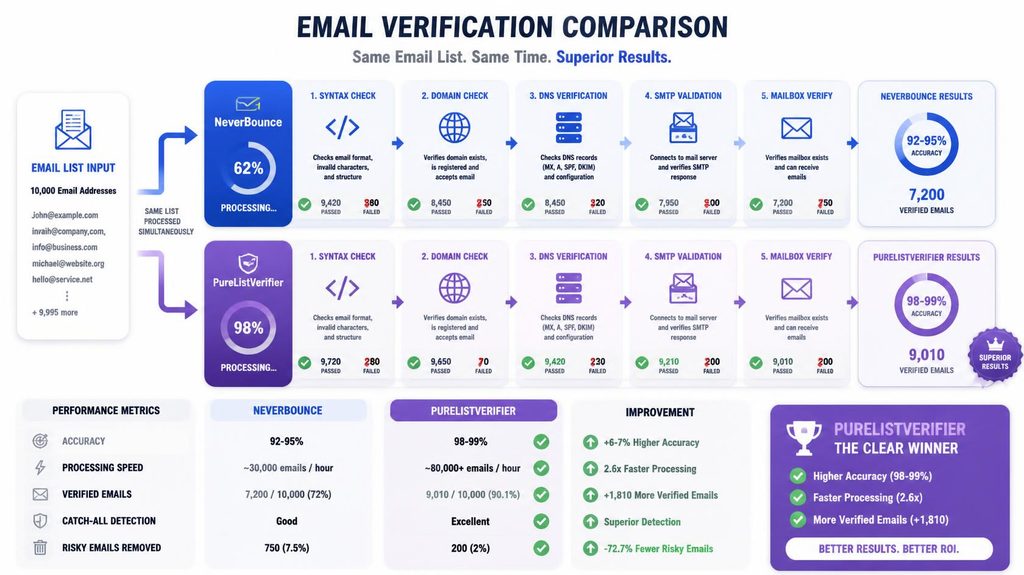
Rather than deciding purely from pricing pages, a short, practical test settles this faster than reading comparisons: take a sample of a few hundred addresses from a list you already know reasonably well, run it through both NeverBounce and a standalone alternative like PureListVerifier, and compare how each categorizes the exact same addresses. Pay attention not just to how many come back valid, but how each handles the ambiguous catch-all portion specifically, since that’s usually where results diverge most between providers. This costs a small amount of time and a handful of credits on each side, and it tells you more about real-world fit than any published accuracy number will.
What actually changed for customers after the ZoomInfo acquisition
Acquisitions of standalone tools by larger platforms tend to follow a familiar pattern: the acquired product’s roadmap starts prioritizing integration with the parent company’s broader suite, self-serve signup and pricing pages sometimes become less prominent in favor of sales-assisted conversations, and support may shift toward account teams rather than a simple ticket queue. This isn’t unique to NeverBounce, it happens across the industry whenever a focused point solution gets folded into a larger platform. For existing NeverBounce customers who were already happy with the standalone product, these changes are sometimes barely noticeable; for prospective new customers evaluating it fresh today, it’s worth going in aware that you may be adopting part of a larger platform relationship rather than a single narrowly-scoped tool.
How NeverBounce’s core verification actually works
Setting pricing and ownership aside, NeverBounce’s underlying verification process follows the same general approach as most established providers in this space: syntax checking, domain and mail server validation, and a mailbox-level check where possible, with results categorized into buckets like valid, invalid, and catch-all. This is worth knowing because the actual checking methodology across most reputable providers, NeverBounce included, is broadly similar, the real differences between tools tend to show up in pricing structure, integration options, and how edge cases like catch-all domains are handled and billed, not in some fundamentally different verification technology.
How to actually evaluate any verification tool, NeverBounce included
- Test it on a real sample of your own list rather than trusting a published accuracy percentage alone, since self-reported numbers use each provider’s own methodology and test data.
- Check how pricing behaves at your actual volume, not just the entry-level tier, since credit-based and subscription pricing can scale very differently once you’re past a starting plan.
- Confirm the signup and account setup process fits how you want to buy, a fast self-serve signup versus a sales-assisted process tied to a larger platform.
- Ask directly how catch-all and ambiguous results are handled and billed, since this detail affects your real effective cost per address more than the headline price often suggests.
What migrating away from NeverBounce actually involves
Switching verification providers is generally low-friction, since these tools work on lists you upload or connect rather than storing an ongoing relationship with your subscribers the way an email sending platform does. In practice, migrating means exporting or disconnecting any current integration, signing up with the new provider, and re-pointing your signup form or CRM’s verification step to the new API or upload process. There’s no subscriber-side disruption, your contacts never see or interact with the verification tool directly, so the switch is entirely a backend change on your side.
Questions worth asking before you decide either way
- What’s your actual monthly or annual verification volume, and does that make a flat subscription or pay-as-you-go credits cheaper in practice?
- Do you already use other ZoomInfo products, where bundling adds real convenience rather than unnecessary complexity?
- How important is a fast, simple signup process versus being comfortable navigating a larger platform’s account structure?
- Does either provider’s catch-all handling and pricing materially change your effective cost per address at your typical list composition?
The bottom line for most people comparing the two
If you’re already inside the ZoomInfo ecosystem, bundling verification there is a reasonable, low-friction choice. If you’re evaluating verification tools from scratch with no existing ZoomInfo relationship, a standalone subscription tends to mean a faster signup, simpler pricing to reason about, and no need to navigate a larger platform’s account structure just to check a list. Neither path is wrong, they’re built for genuinely different starting points.
Frequently asked questions
Is NeverBounce owned by ZoomInfo?
Yes, ZoomInfo acquired NeverBounce in 2021, and it now operates as part of ZoomInfo’s broader sales and marketing platform.
Does NeverBounce have a free trial?
NeverBounce has offered a small number of free verification credits for new signups in the past; check its current pricing page directly, since terms tied to a larger platform tend to change more frequently than a standalone tool’s.
How does NeverBounce pricing work?
It’s pay-as-you-go, priced per verification credit, with the per-credit cost dropping as you purchase larger packs, rather than a flat recurring monthly subscription.
Can you use NeverBounce without a ZoomInfo account?
It’s generally still accessible on its own, but as part of a larger company, expect more account setup and potential sales contact than a smaller, independent verification tool typically involves.
Is switching away from NeverBounce difficult?
No. Verification tools work on lists you upload or connect rather than an ongoing subscriber relationship, so switching is mainly a backend change, re-pointing your signup form or CRM’s verification step to a new provider.
Is NeverBounce’s verification technology fundamentally different from other tools?
Not really. Most established providers, NeverBounce included, use a broadly similar approach of syntax, domain, and mailbox-level checking. The real differences show up in pricing, integrations, and how edge cases like catch-all domains are handled.
Where to start
If you already run on ZoomInfo, staying put is reasonable. If you just want a straightforward, standalone way to check a list without the extra account layers, PureListVerifier’s flat monthly plans are worth comparing against what you’d actually pay in NeverBounce credits.

1 comment