

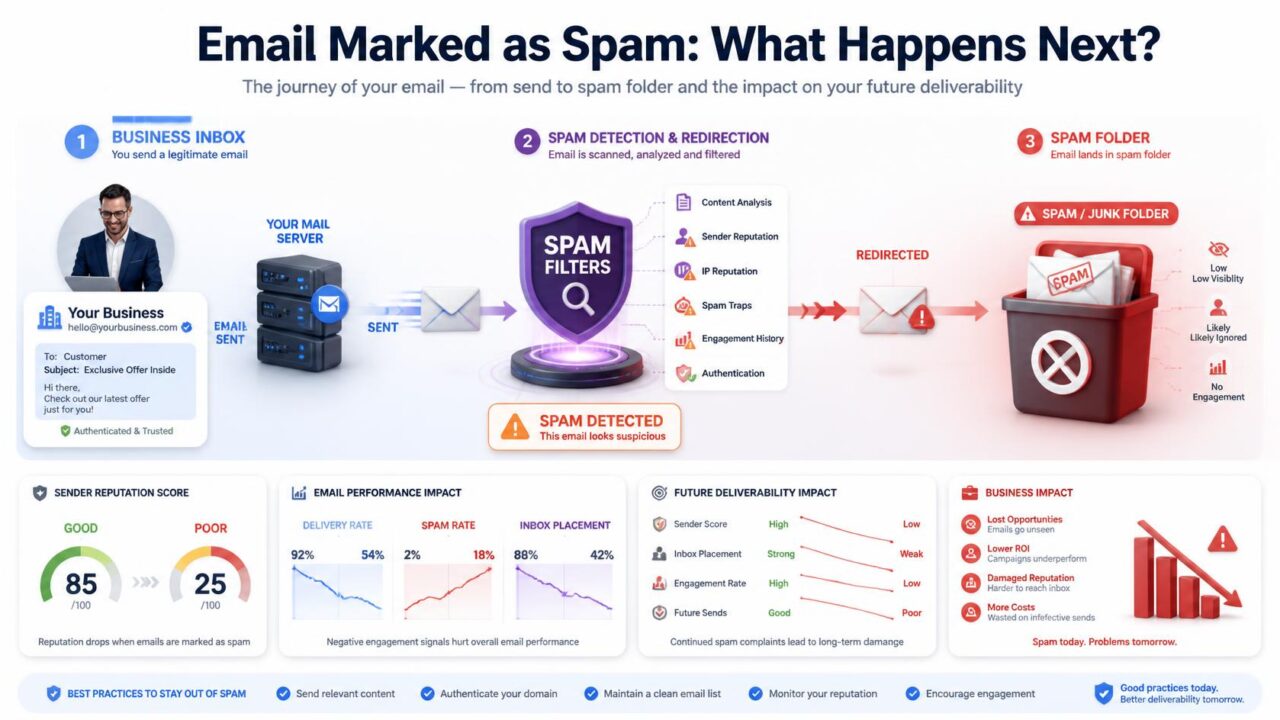
One person marking one email as spam rarely does anything dramatic on its own. What actually matters is the rate, how many complaints you get relative to how many emails you send, tracked over time. A single complaint is noise. A rising pattern is a real signal that mailbox providers act on.
Quick answer: one complaint by itself does very little. A complaint rate approaching roughly 0.3%, about 3 per 1,000 emails sent, is where major mailbox providers start treating it as a serious warning sign. The complaining address gets automatically suppressed from future sends on most platforms, and you generally can’t find out who specifically reported you, since that data is anonymized to protect the recipient.
Why mailbox providers weigh complaints so heavily
Of all the signals a mailbox provider uses to judge a sender, a spam complaint is unusual because it’s the recipient explicitly, deliberately telling the provider “I don’t want this,” rather than the provider inferring intent from indirect behavior like a low open rate. Bounces can happen for technical reasons unrelated to intent. A low open rate could mean someone’s simply busy that week. A spam complaint carries none of that ambiguity, it’s a direct, first-party statement from the person the email was addressed to. That’s exactly why providers treat it as a stronger, more trustworthy signal than most other engagement metrics, and why a rising complaint rate gets acted on faster and more decisively than a slowly declining open rate would.
What actually happens, step by step
- The recipient clicks “Report spam” instead of unsubscribing or simply deleting the email.
- Their mailbox provider logs it against your sending domain and IP, adding one data point to your ongoing complaint rate.
- Many providers report this back to you or your email platform through something called a feedback loop, so major senders can see complaint data and, in some cases, automatically suppress that address from future sends.
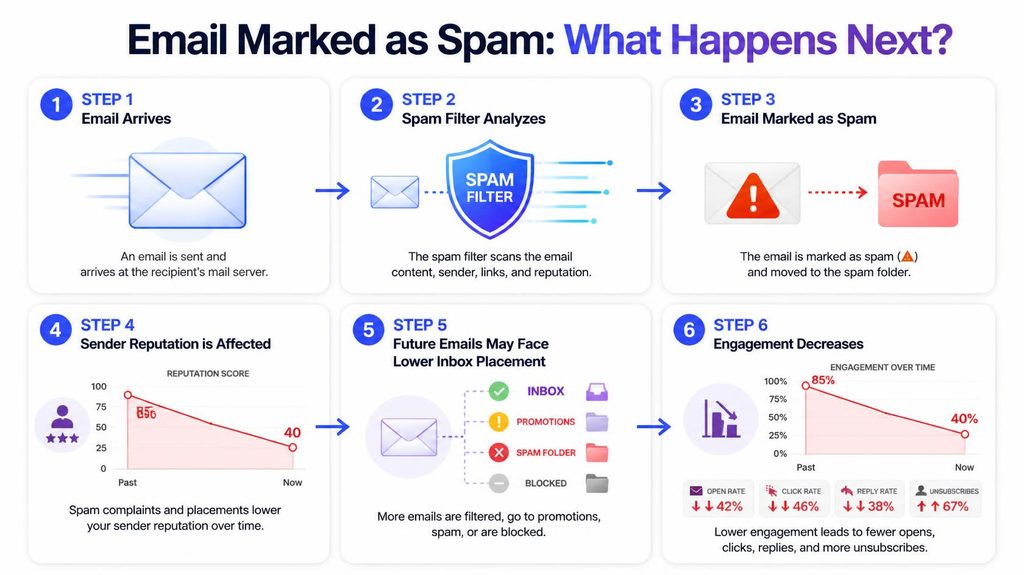
- The complaint gets factored into your sender reputation alongside your bounce rate, engagement, and authentication status, not evaluated in isolation.
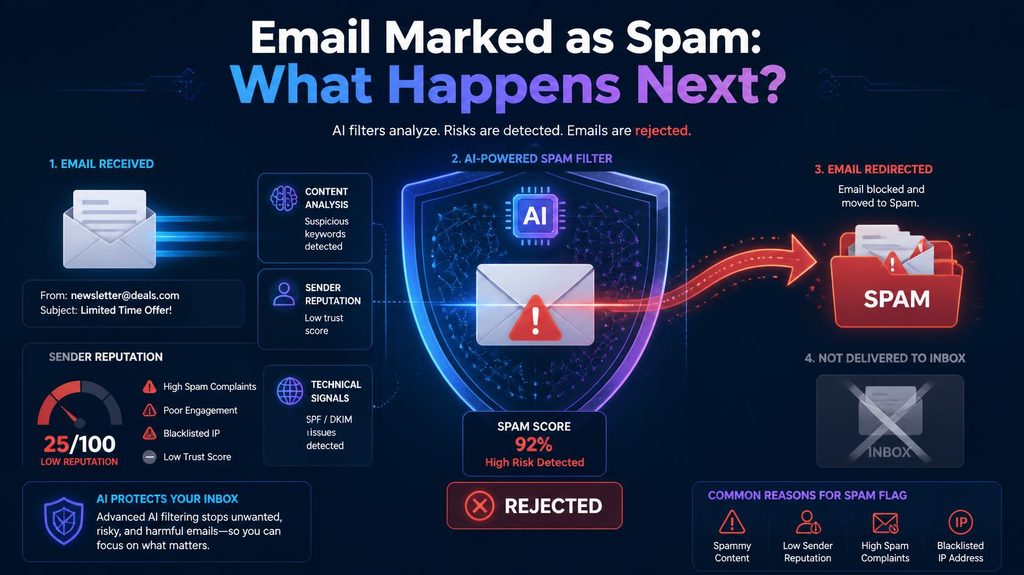
- If your overall complaint rate crosses a threshold, providers start filtering more of your mail to spam for everyone, not just the person who complained.
Does one complaint actually hurt you?
Practically, no. Mailbox providers understand that a small number of complaints happens to every legitimate sender, since some recipients report spam out of habit rather than genuine reason, even for email they technically signed up for. What they’re watching for is a rate that’s meaningfully higher than normal, not the mere existence of any complaints at all.

What complaint rate is considered dangerous?
Most major mailbox providers, including Google’s published bulk sender guidance, treat a complaint rate around 0.3% as a serious warning threshold, with rates approaching or exceeding that treated as grounds for filtering or rejecting mail outright. To put that in perspective, that’s roughly 3 complaints per 1,000 emails sent, which is a lower bar than it might sound like.
It also helps to know where “normal” actually sits, since 0.3% is a danger ceiling, not a typical rate. Industry benchmark data tells a more reassuring story for well-run lists: Validity’s Email Marketing Insights research has put the broader average spam complaint rate around 0.07%, and other industry benchmark studies report averages as low as 0.01-0.05% across sectors, with well-managed professional and B2B sending often landing under 0.05%. In other words, a healthy list usually operates six to ten times below the danger threshold, which is exactly why even a moderate uptick, well before you’d ever approach 0.3%, is worth investigating rather than waiting for the number to become a real problem.
Can you find out who marked your email as spam?
Generally, no, not directly. Complaint data reported through feedback loops is typically aggregated and anonymized specifically to protect the recipient’s privacy, since knowing who reported you could otherwise be used to retaliate or pressure that person. What you can see is your overall complaint rate and, on some platforms, which specific email address triggered a complaint, so you can at least suppress it from future sends.
Does that person still receive your future emails?
Usually not. Most email platforms automatically suppress an address the moment it generates a spam complaint, treating it functionally the same as an unsubscribe going forward. Continuing to email someone who’s already complained once significantly raises the odds they complain again, and repeated complaints from the same recipient are treated as a stronger signal than a single one. It’s worth double-checking that your specific platform’s suppression setting is actually enabled rather than assuming it, since a misconfigured account can occasionally keep sending to a complaining address by mistake.
What this looks like in a real inbox report
Imagine a monthly campaign sent to 20,000 people that generates 15 spam complaints, a complaint rate of 0.075%, comfortably under the 0.3% danger threshold. On its own, this isn’t a cause for concern, and most senders would rightly leave it alone. Now imagine the same list, but the complaints climb to 70 on the next send, a rate of 0.35%, just past the threshold, with no obvious change in content. That jump, not the raw number of complaints, is the actual signal worth investigating, since it suggests something specific changed, a list quality issue, a segment that shouldn’t have been included, or a shift in how the email was perceived, rather than simply “some people always complain.”
Why people mark email as spam instead of unsubscribing
- They can’t find the unsubscribe link, or it’s buried too far down to notice quickly.
- They don’t remember signing up, especially on a list they joined a long time ago or through an unclear signup flow.
- It’s simply faster. Reporting spam is often a single click directly in the inbox, while unsubscribing usually means visiting a separate page.
- They feel like they never really opted in, which is more common on purchased, scraped, or poorly-sourced lists.
A meaningful share of complaints are really unsubscribes in disguise, from people who would have happily clicked “unsubscribe” if it had been easier to find.
What to do right after you notice a rise in complaints
- Pull your complaint rate for the last several sends, not just the most recent one, to see whether it’s a genuine trend or a single unusual send.
- Identify which specific send or segment the complaints are concentrated in. A spike tied to one particular email, or one particular list segment, points at a narrower, more fixable cause than a general rise across everything.
- Check whether it coincides with a list change, a recent import, a purchased or scraped list, or a segment you haven’t emailed in a long time, since these are common triggers.
- Pause sending to the affected segment while you investigate, rather than continuing to send into a pattern that’s already generating complaints.
- Review the email itself for anything that might have surprised or confused recipients, an unclear sender name, a subject line that didn’t match the content, or a sudden change in how often you’re sending.
Does industry affect what a “normal” complaint rate looks like?
Somewhat. E-commerce and consumer marketing lists, which tend to include a wide range of engagement levels, often run slightly higher baseline complaint rates than tightly opted-in B2B or professional newsletters. That said, the roughly 0.3% danger threshold used by major mailbox providers is applied fairly consistently across industries, so “normal for my industry” isn’t a safe reason to ignore a rate approaching that level.
The mindset shift that actually helps here
It’s easy to take a spam complaint personally, especially the first time you notice one, but the more useful mental model is treating your complaint rate as a single ongoing metric to manage, not a series of individual judgments about your content or your relationship with each recipient. Marketers with genuinely healthy, long-running lists still see complaints regularly, because at any meaningful scale, some small percentage of people will always click that button rather than unsubscribe, regardless of how good the sender is. The goal was never zero complaints, it’s keeping the rate low and stable enough that it never becomes the signal mailbox providers act on.
How to keep your complaint rate low
- Make unsubscribing genuinely easy, visible near the top of the email, not just buried in the footer.
- Only email people who clearly opted in, and avoid purchased or scraped lists entirely.
- Check your list regularly, since dead and disposable addresses are more likely to sit unrecognized and generate complaints from confused recipients.
- Sunset unengaged contacts rather than emailing everyone indefinitely, since people who’ve forgotten about you are more likely to report you than to unsubscribe cleanly.
- Remind people how they joined your list, briefly, especially in emails to contacts you haven’t messaged in a while.
What if complaints keep coming from the same type of contact?
If you notice complaints clustering around a specific acquisition source, a particular lead magnet, a specific event, a specific paid ad campaign, that’s a strong, specific signal worth acting on directly, rather than treating your whole list as equally at risk. It usually means that specific source is bringing in people who didn’t clearly understand what they were signing up for. Fixing the signup flow or messaging for that specific source, or discontinuing it if it’s a small enough share of your list, addresses the root cause far more directly than general list hygiene alone.
Frequently asked questions
Does one spam complaint actually hurt your sending?
Practically, no. Providers expect a small number of complaints from any legitimate sender. What matters is your overall rate over time, not any single complaint in isolation.
Can you find out who marked your email as spam?
Generally no. This data is typically aggregated and anonymized to protect the recipient, though your platform may show which specific address triggered a complaint so you can suppress it.
Does someone who marks you as spam still get your future emails?
Usually not. Most platforms automatically suppress that address going forward, treating it the same as an unsubscribe.
What complaint rate is considered dangerous?
Around 0.3% is a commonly cited danger threshold, roughly 3 complaints per 1,000 emails sent. Rates near or above that are treated as a serious warning sign by major mailbox providers.
What should you do the moment you notice a rise in complaints?
Check whether it’s a genuine trend across several sends or a single outlier, identify which segment or send the complaints are concentrated in, and pause sending to that segment while you investigate rather than continuing on the same pattern.
Is a “normal” complaint rate different by industry?
Somewhat, consumer and e-commerce lists often run slightly higher than tightly opted-in B2B lists. But the roughly 0.3% threshold major providers watch for applies fairly consistently regardless of industry, so it’s not safe to assume your higher rate is fine just because it’s “normal” for your sector.
Where to start
If you’ve noticed a rise in complaints, check your list for confused or unrecognized contacts before assuming it’s a content problem. PureListVerifier helps make sure the people you’re emailing are real, current addresses, which is the first line of defense against complaints from people who don’t recognize you anymore.
