

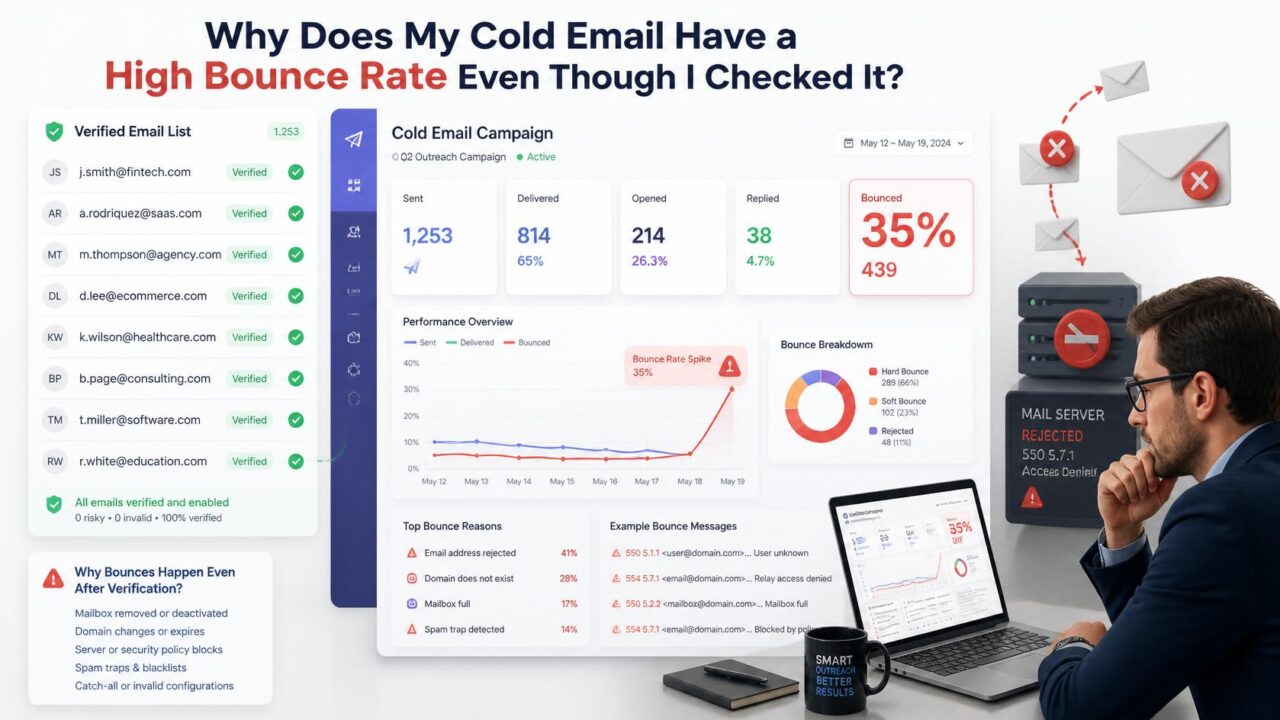
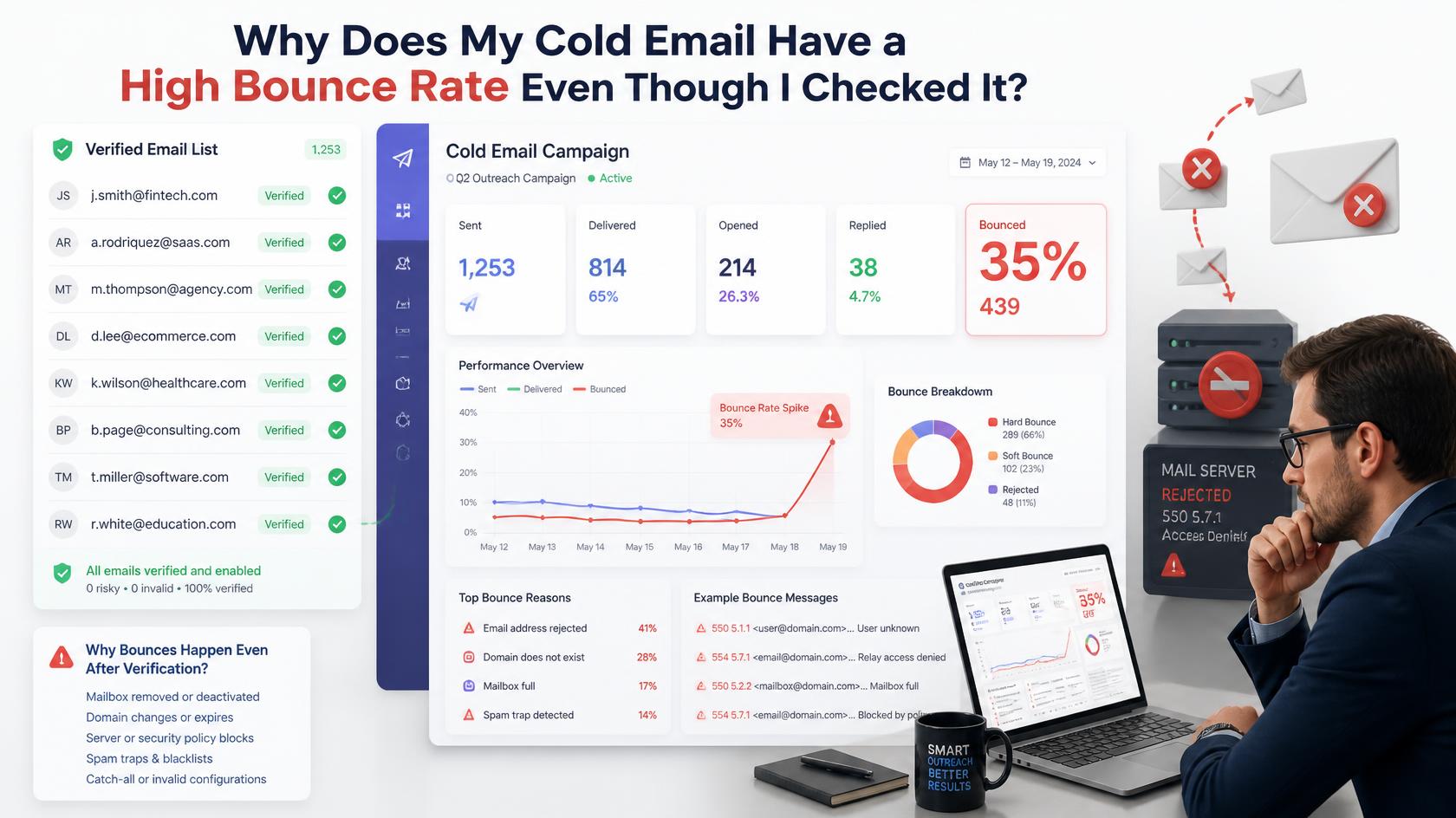
Quick answer: B2B contact data goes bad fast, commonly estimated at somewhere between 2% and just under 6% a month depending on the source and industry, which compounds to roughly 12-25%+ of a list becoming inaccurate within a single year. If your list was verified weeks or months before you actually sent to it, or the underlying data itself was already old when you checked it, the gap between “checked” and “sent” is exactly where a verified list quietly goes bad again.
Why this feels so counterintuitive
It’s a reasonable instinct to treat “verified” as a permanent state, the same way you might treat a passport or a driver’s license as valid until an explicit expiration date printed right on it. Email addresses don’t work that way. There’s no expiration date, no renewal notice, and no central authority tracking when an address stops working, it simply stops, silently, the moment the person behind it changes jobs or the company shuts down the account. That silent, uneventful nature is exactly what makes a bounce feel like a surprise, even though, statistically, it was always likely to happen to some percentage of any list given enough time.
Why “checked” and “still valid” aren’t the same promise
Verification confirms an address was reachable at the exact moment you ran the check, nothing more. It’s not a permanent stamp of approval, it’s a timestamped fact. Between the moment you check a list and the moment you actually send to it, real people behind those addresses keep changing jobs, closing accounts, and having their old work email deactivated by IT departments who don’t send you a heads-up first.

How fast B2B contact data actually decays
This isn’t a small, theoretical effect. Multiple independent studies of B2B contact databases converge on a consistent, uncomfortable picture:
- Lusha’s own measured study of its database found a 12.6% annual decay rate for B2B contact data.
- Other industry analyses put annual decay considerably higher, in the 22.5% to 35% range, with monthly decay commonly cited around 2.1%.
- Job changes are the biggest driver. Roughly 70.8% of business contacts experience some kind of change (title, phone, or email) within 12 months, and separately, professional job-change rates generally run in the 20-30% range annually, higher still in fast-moving sectors like software and agencies.
- Email specifically is affected in an estimated 37.3% of contacts experiencing some change within a year, according to one widely cited industry analysis.
Put simply: even a perfectly, freshly verified list starts decaying again the moment the check finishes. See why lists get worse over time for the mechanics behind this on any list, not just cold outreach specifically.
Why the numbers vary so much between sources
You may notice the decay estimates cited above span a fairly wide range, from around 12.6% to over 22.5% annually depending on the study. This isn’t sloppiness on any one source’s part, it reflects genuinely different underlying databases, industries, and measurement methods. A database weighted toward fast-moving sectors like tech and agencies will show faster decay than one weighted toward more stable industries. A study measuring only email addresses specifically will differ from one measuring any contact field change (title, phone, email combined). Rather than fixating on which exact number is “correct,” the more useful takeaway is the consistent direction across every single study: B2B data decays meaningfully within months, not years, regardless of which specific figure you use.
The gap that actually causes this: timing
The most common, fixable cause of “I checked it and it still bounced” isn’t a broken verification tool, it’s the time gap between checking and sending. A list verified in January and finally sent to in April has had a full quarter to decay, roughly 6-18% worth by the estimates above, entirely unrelated to how good the original check was. The fix isn’t a better verification tool, it’s verifying closer to your actual send date, not treating a check from months ago as still current.
A realistic timeline of how this happens
Picture a typical outreach project: a list of 5,000 target contacts gets pulled together over two weeks of research, then verified once that research is finished. But the actual campaign doesn’t launch immediately, it waits on final message approval, a sequence being built in the outreach tool, and a launch date tied to a product release three months out. By the time the first email actually goes out, roughly three months have passed since verification, and using the 2.1%-a-month baseline decay estimate, that list has likely lost somewhere in the range of 6-18% of its accuracy in the gap between checking and sending, entirely separate from anything wrong with the original verification. The bounce rate on launch day reflects that gap, not a failure of the check itself.
The source of the list matters as much as the check
A second, less obvious factor: verification confirms an address is reachable, but it can’t tell you how old the underlying data was before you ever checked it. A contact list built from a database that was itself compiled a year or two ago starts you off already behind, since a meaningful share of it may have already decayed before you ran your first check. This is a separate problem from verification accuracy, and it’s why the same verification tool can produce very different real-world results depending on how fresh the source list actually was.
What a “reasonable” bounce rate actually looks like on cold outreach
It’s worth setting realistic expectations rather than aiming for zero. Even a freshly verified, well-sourced cold outreach list will typically still show some small bounce rate on send, since verification and decay are both imperfect and ongoing, not because anything went wrong. A bounce rate that stays low and stable, ideally under 2-3% even on cold outreach, suggests your process is working as expected. A rate climbing well beyond that, or spiking noticeably compared to your own past campaigns, is the signal actually worth investigating using the causes above, rather than treating every single bounce as evidence something is broken.
What to actually do about it
- Verify as close to send time as possible, ideally within days, not weeks or months, especially for cold outreach where there’s no ongoing relationship keeping your data current.
- Treat list age as its own risk factor, separate from verification. A list that’s been sitting for six months needs a fresh check regardless of how thoroughly it was checked originally.
- Prioritize freshness over volume when sourcing contacts. A smaller, recently updated list will consistently outperform a larger, older one, even after both are verified.
- Build re-verification into your actual outreach workflow, not as an occasional afterthought, particularly if there’s typically a delay between building a target list and actually sending to it.
- Don’t blame the tool for a timing problem. A verification tool did its job correctly if it confirmed an address at the time you ran it. What happened after that is a separate, natural process, not a failure of the check itself.
Why this hits certain industries harder
Decay isn’t evenly distributed across every industry you might be targeting. Fast-moving sectors like software, digital agencies, and professional services tend to sit at the higher end of typical job-change ranges, since these industries see more frequent hiring, promotions, and turnover than more stable, slower-moving fields. If your outreach specifically targets tech companies or agencies, treat the decay estimates in this article as a floor rather than a ceiling, and lean toward checking closer to send time than you might for a more stable target industry.
Should you always re-verify right before sending?
For cold outreach specifically, yes, this is worth treating as a standard step rather than an optional one. Unlike an opted-in list where ongoing engagement gives you natural, continuous signal about who’s still reachable, cold outreach has no such feedback loop until you actually send and start seeing bounces. See what to check before sending a cold email for the fuller pre-send checklist this fits into.
Frequently asked questions
How long does a verified email list actually stay accurate?
Based on typical B2B decay rates, expect meaningful degradation within just a few weeks to a couple of months, and treat anything older than that as needing a fresh check before you rely on it again.
Does the age of the source list matter more than how it was verified?
It can, yes. Verification only confirms current reachability, it can’t undo the fact that a list built from stale, outdated source data started off already partly decayed before you ever checked it.
Should you re-verify a list right before sending, even if you checked it recently?
For cold outreach specifically, yes, especially if any real time has passed since the original check. There’s no ongoing relationship keeping the data fresh the way there is with an opted-in list.
Is a high bounce rate always the verification tool’s fault?
No. If enough time passed between checking and sending, or the source data was already old, natural data decay is a more likely explanation than a flawed check. A verification tool can only confirm what was true at the moment it ran.
Does industry affect how fast a list decays?
Yes. Fast-moving sectors like software, agencies, and professional services tend to see higher job-change rates, and therefore faster data decay, than more stable industries. Adjust how often you re-verify based on who you’re actually targeting.
What’s a reasonable amount of time to allow between checking and sending?
As short as your workflow allows, ideally days rather than weeks. If a real gap is unavoidable due to campaign planning or approval processes, build in a second, fresh check right before the actual send date.
Where to start
If there’s any real gap between when you built or checked your outreach list and when you actually plan to send, close that gap with a fresh check first. PureListVerifier makes re-checking a list fast enough to build into your workflow right before every send, not just once at the start.
