

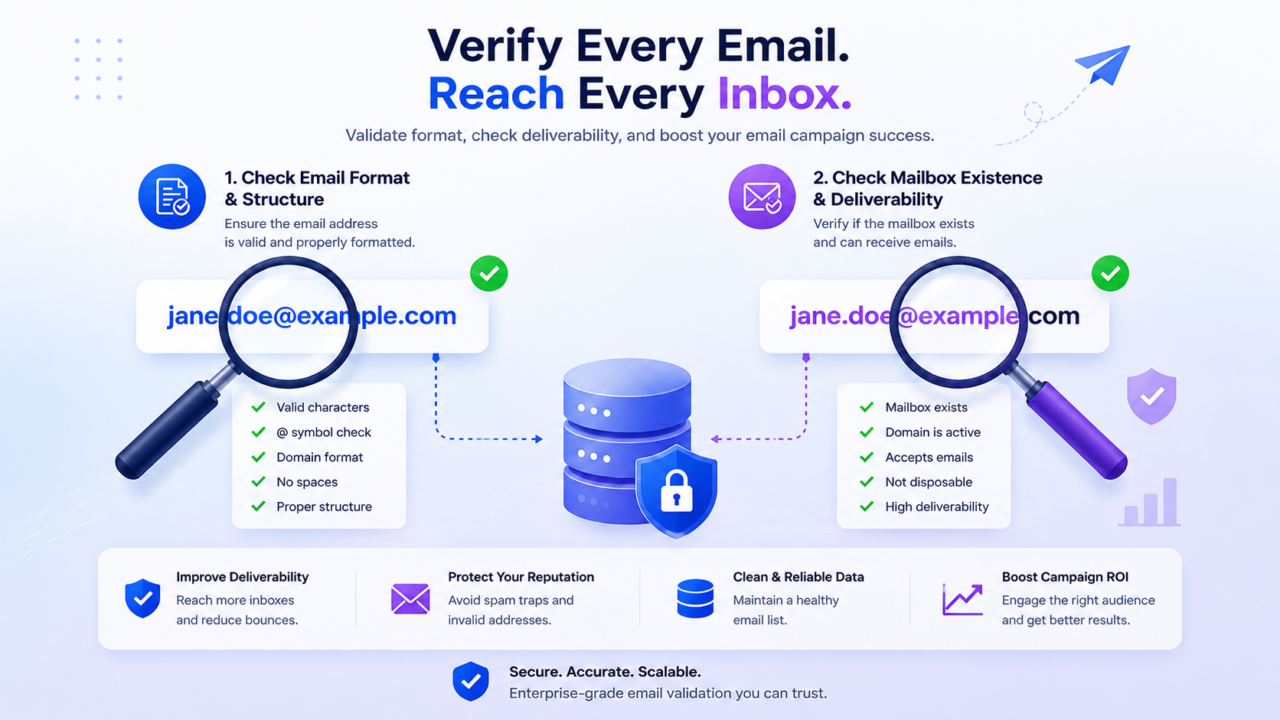
Two providers describe the same product in different words. One sells “email validation”, the other sells “email verification”. The pricing looks similar, so you assume the service is too. Then one of them returns a clean list that still bounces.
The two terms are used loosely across the industry, but they describe genuinely different amounts of work. Knowing which one you are buying, and which one you actually need, is the difference between a list that delivers and a list that only looks tidy.
The short answer
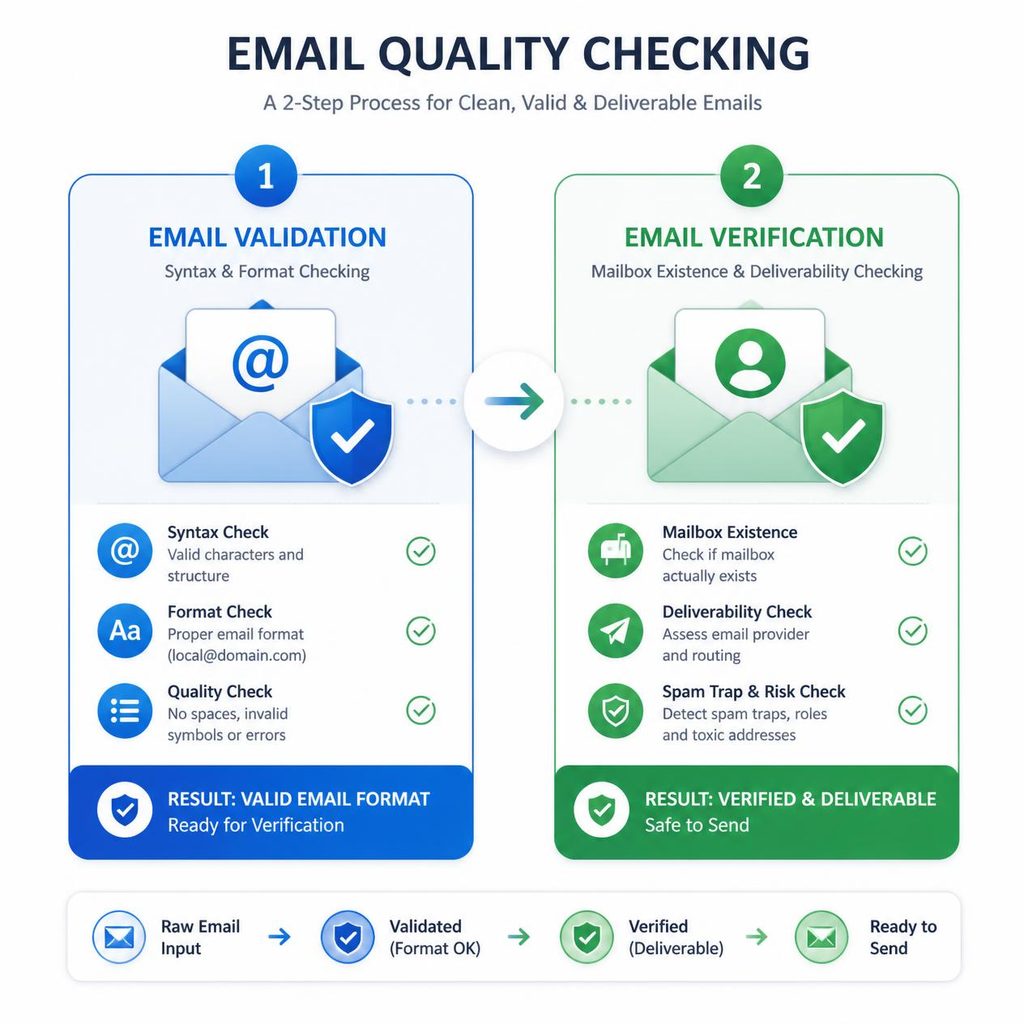
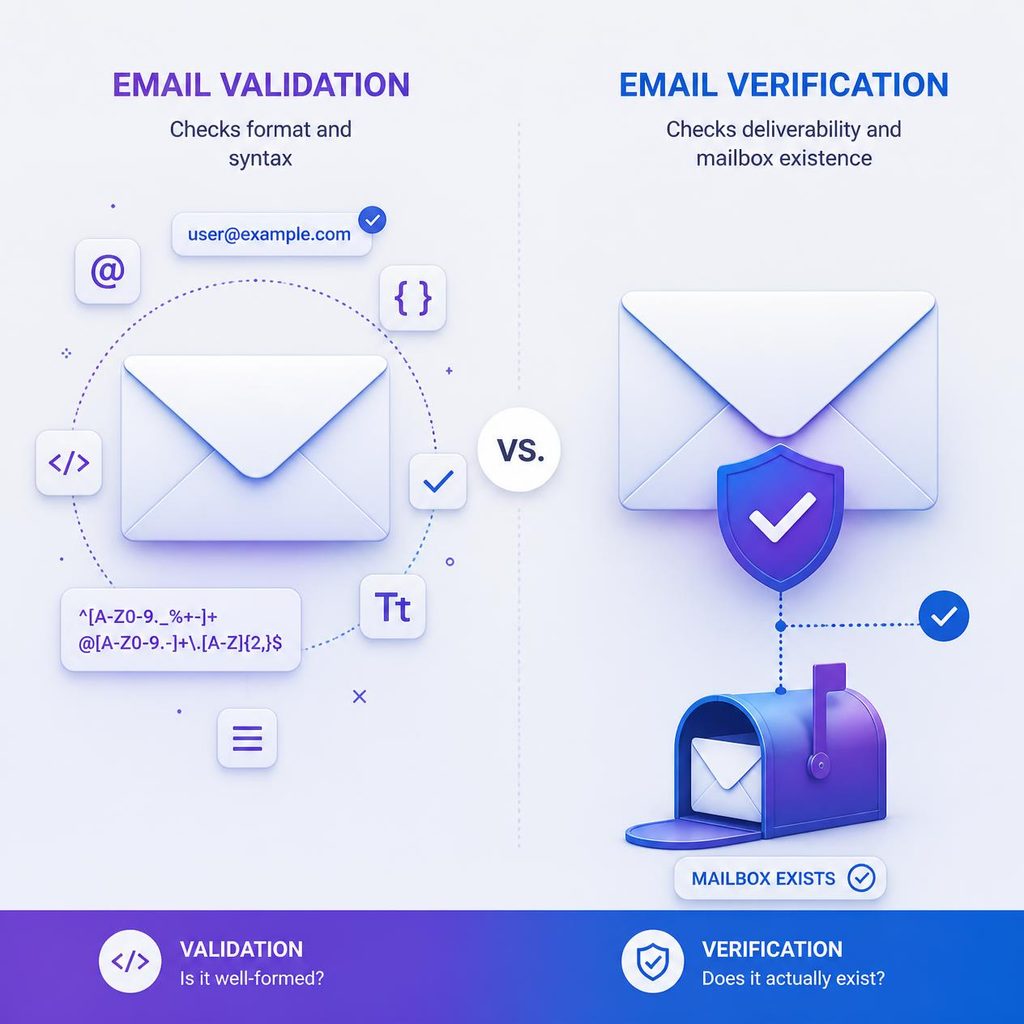
Validation checks whether an address is written correctly. Verification checks whether it actually exists and can receive mail.
Validation is a rules check that happens instantly and offline. Verification requires talking to the receiving mail server. That single difference explains everything else: the speed, the price, the accuracy, and what each one can and cannot protect you from.
What is Email Validation?
Email validation checks the structure of an address against the rules that define what an email address may contain. It asks whether the string is a plausible address, not whether anyone is behind it.
A validator confirms things like:
- There is exactly one @ symbol
- There is a local part before it and a domain after it
- The domain contains a dot and a plausible extension
- There are no spaces or illegal characters
- The address is not absurdly long
This is what the browser does when a form field is marked as type=”email”. It is instant, free, and it never contacts anyone.
What validation catches
Genuine typing mistakes. Somebody enters sarah@gmail with no extension, or sarah gmail.com with a space instead of the symbol, or leaves the field half-filled. Those are caught immediately, and catching them at the form is worth doing.
What validation misses
Everything that matters most. Consider notreal@gmail.com. It passes validation perfectly: correct structure, real domain, valid extension. It is also completely undeliverable, because no such mailbox exists.
The same is true of an address at a company that closed two years ago, an address belonging to an employee who left, and every disposable address ever created. All of them are perfectly formed. None of them will accept your email.
This is the trap. Validation gives a clean-looking pass on addresses that will hard bounce, which produces confidence without protection.
What is Email Verification?
Email verification asks a harder question: does this mailbox exist, and will the server accept mail for it?
Answering that requires several stages, each one going further than the last:
- Syntax check. Verification includes validation. It is the first step, not a competing approach.
- Domain and MX lookup. Does the domain resolve, and does it publish MX records naming the servers that receive its mail? A domain without MX records cannot accept email at all.
- Mailbox check. The service connects to the receiving server and begins the exchange that delivering a message would start, then stops before anything is transmitted. The server usually indicates whether the specific mailbox exists.
- Risk checks. Is the address disposable? Is it a shared role account such as info@? Is it associated with previous complaints?
- Classification. Everything learned becomes one status you can act on.
Because verification involves network requests to servers you do not control, it takes longer and costs money. That cost is the reason the distinction exists at all.
Side by side
| Validation | Verification | |
| Question it answers | Is this written correctly? | Does this mailbox exist and accept mail? |
| How it works | Pattern matching against rules | DNS lookups plus a live server check |
| Network needed | No | Yes |
| Speed | Instant | Fractions of a second to several seconds |
| Cost | Effectively free | Priced per address |
| Catches typos | Yes | Yes |
| Catches dead mailboxes | No | Yes |
| Catches disposable addresses | No | Yes |
| Catches role accounts | No | Yes |
| Prevents hard bounces | Barely | Substantially |
Read the bottom four rows together and the practical difference becomes obvious. Validation removes the addresses a careful person would have spotted anyway. Verification removes the ones nobody could spot by looking.
A worked example
Abstract definitions only go so far. Here are five addresses of the kind that appear on any real list, put through both checks.
| Address | Validation says | Verification says |
| sarah@gmail | Fail: no extension | Fail: invalid |
| sarah@gmial.com | Pass: correctly structured | Fail: domain has no mail records. Suggests gmail.com |
| notreal99@gmail.com | Pass: perfectly formed | Fail: mailbox does not exist |
| temp@mailinator.com | Pass: real domain, valid format | Flagged: disposable address |
| info@realcompany.com | Pass | Flagged: role account, shared inbox |
Four out of five pass validation. Only one survives verification without a warning.
Look at the third row in particular. It is the one that costs you. There is nothing visibly wrong with notreal99@gmail.com: real domain, sensible structure, nothing a human reviewer would question. It will still hard bounce, and that bounce is recorded against your sending reputation exactly like every other one. No amount of format checking would ever have found it, because there is nothing about the format to find.
The fourth and fifth rows show the other half of the gap. Both addresses genuinely work, so a pass or fail answer is the wrong shape for them. A disposable inbox will accept your welcome email and be abandoned within the hour. A shared info@ address is read by several people, none of whom personally subscribed, which is why role accounts generate complaints out of proportion to their number. Verification does not simply delete these, it labels them, and the label is what lets you decide.

Why the distinction matters in practice
False confidence is worse than no check
A team that validates its list believes it has cleaned it. It has not, and the belief prevents the real clean from happening. When the campaign bounces, the list is usually the last place anyone looks, because the list “was already checked”.
Providers use the words interchangeably
Plenty of genuine verification services market themselves as “email validation”, because that is the phrase more people search for. The name on the pricing page tells you very little. What the service actually does is a separate question, and one worth asking directly.
Only one of them protects your sender reputation
Mailbox providers judge senders partly on how often they send to addresses that do not exist. Format checking has no effect on that number, because badly formatted addresses were never going to be delivered anyway. Only mailbox-level verification moves it.
Where list cleaning fits in
A third term you will meet is “list cleaning,” sometimes called list hygiene. It is broader than both of the others.
| Term | Scope |
| Validation | Format only |
| Verification | Format, domain, mailbox existence, risk flags |
| List cleaning | All of the above, plus duplicates, unsubscribes, previous complainers, and contacts who have not engaged in a long time |
Verification is a technical question about the address. Cleaning also involves judgement about the relationship: someone who has ignored eighteen months of campaigns has a working mailbox and is still worth removing.
Which one do you need?
In almost every real case, both. They belong at different points in the process.
| Situation | Use |
| Someone is typing into your signup form | Validation for instant feedback, then verification through an API before the record is saved |
| You are about to email a list you already hold | Verification, in bulk |
| You have imported a list from an event, partner or CRM | Verification, before the first send |
| You are re-engaging contacts who have been quiet for a year | Verification, then engagement-based segmentation |
| You only want to stop obvious typos | Validation alone, and accept it will not prevent bounces |
The pattern worth copying: validate in the browser so the person can correct their own mistake, then verify on the server so the mistake nobody noticed never enters your database. PureListVerifier covers the second half through both a bulk uploader and a real-time API.
How to tell what a provider actually does
Ignore the product name and ask these questions instead. The answers separate real verification from format checking quickly.
- Do you perform a mailbox-level check? If the answer is vague, it is a format checker.
- How do you report catch-all domains? A service that never returns a catch-all status is not reaching the mailbox stage. This is the single most revealing question.
- What happens with an ambiguous server response? There should be an unknown category. Anyone reporting every address as either valid or invalid is guessing on some of them.
- Do you flag disposable addresses and role accounts? These require maintained lists, so the answer tells you how actively the service is developed.
- Am I charged for unknown results? Policies differ and it is fair to ask before you buy.
Frequently asked questions
Is email validation useless then?
No. It is the right tool at the moment of typing, because it is instant and free and the person is still there to fix the mistake. It is only a problem when it is mistaken for a full check.
Does verification include validation?
Yes. Syntax checking is the first stage of any verification service. Nothing is skipped by choosing verification.
Can I just use a regular expression to validate addresses?
You can, and most developers do. Be aware that a strict pattern rejects some unusual but legitimate addresses, while a permissive one lets nonsense through. Either way it is still only format checking, so the deliverability question remains unanswered.
Which term should I search for when buying?
Search both, because providers use them interchangeably. Judge on what the service does, particularly whether it reports catch-all and unknown statuses.
Is one of them safer for privacy?
Validation never leaves your system, so nothing is shared. Verification requires sending addresses to a third party, which makes the provider’s data handling a genuine part of the decision. Check retention policy and regional compliance before uploading a customer list.
Does either one confirm the person wants my emails?
Neither. Both are technical checks on the address. Permission is a separate matter, handled by how you collected the address and by double opt-in.
The takeaway
Validation tells you an address is written correctly. Verification tells you it is real. If your goal is fewer bounces, a protected sender reputation and accurate reporting, only the second one gets you there.
Use both, in the right places, and stop treating them as competing options. If you have never run a real mailbox-level check on your list, that first result is usually the most informative thing you will see all quarter. Verify your list with PureListVerifier to see where yours stands.
