

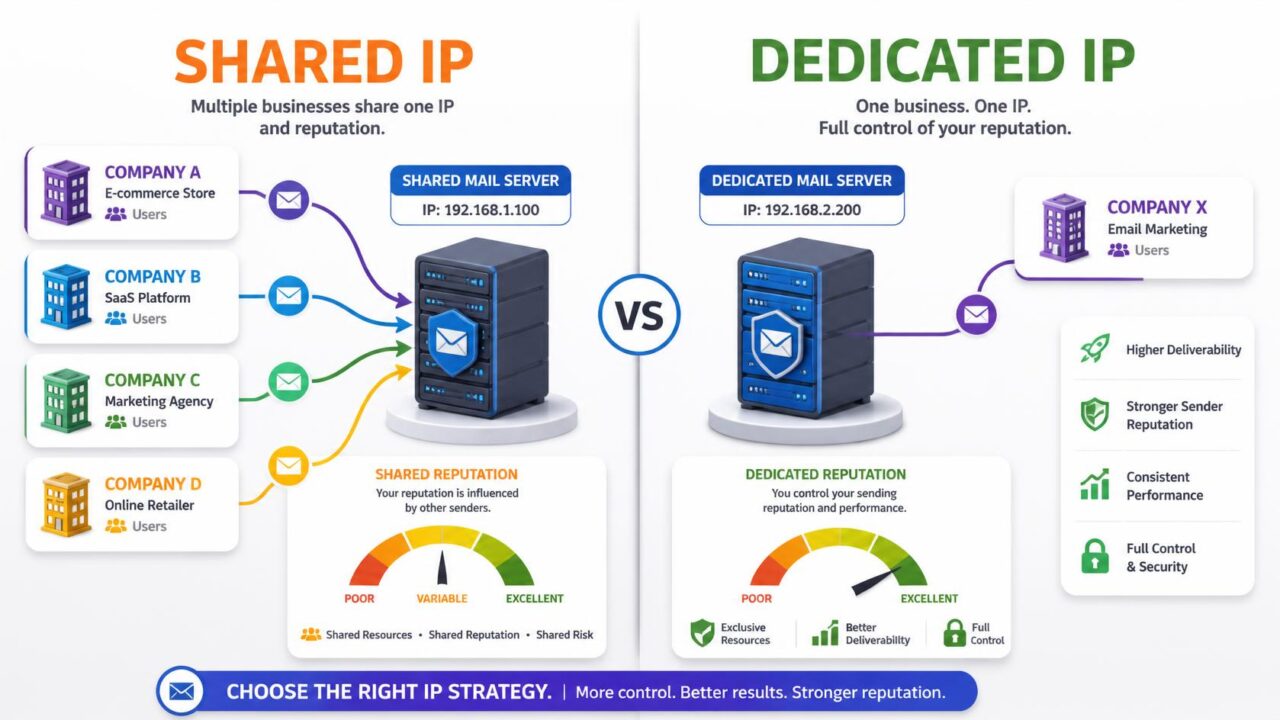
For most senders under roughly 100,000 emails a month, a shared IP is the better choice, not a compromise. A dedicated IP only pays off once you have enough consistent volume to build and maintain a strong reputation on it yourself, since an underused dedicated IP is often worse than a well-managed shared one.
Quick answer: stick with a shared IP below roughly 100,000-250,000 emails a month sent consistently. Above that, and only with steady, predictable volume, a dedicated IP gives you full control over your own reputation, but it still needs its own multi-week warm-up before it’s trustworthy, the same as a brand new domain would.
How email platforms actually decide who gets a shared IP pool
Most major email platforms don’t just dump every customer onto one giant shared IP. They typically maintain several shared pools, sometimes segmented by account tier, sending behavior, or how long a customer has been sending cleanly, and they actively monitor each pool’s collective reputation. A customer who starts generating high bounce rates or complaints can be moved to a more closely watched pool, or in serious cases, suspended entirely, specifically to protect the reputation of everyone else sharing that infrastructure. This is why shared IPs from a reputable, well-run platform tend to perform reasonably well despite the theoretical risk of bad neighbors: the platform has a direct business incentive to police its own shared pools, since a damaged pool reputation affects its ability to serve every customer on it, including the large, high-value ones.
What each option actually means
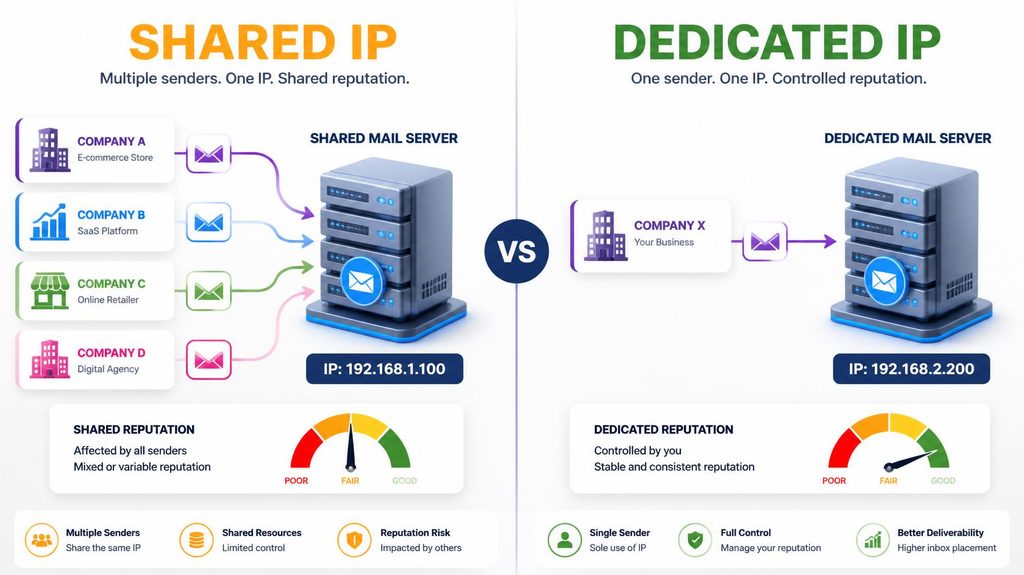
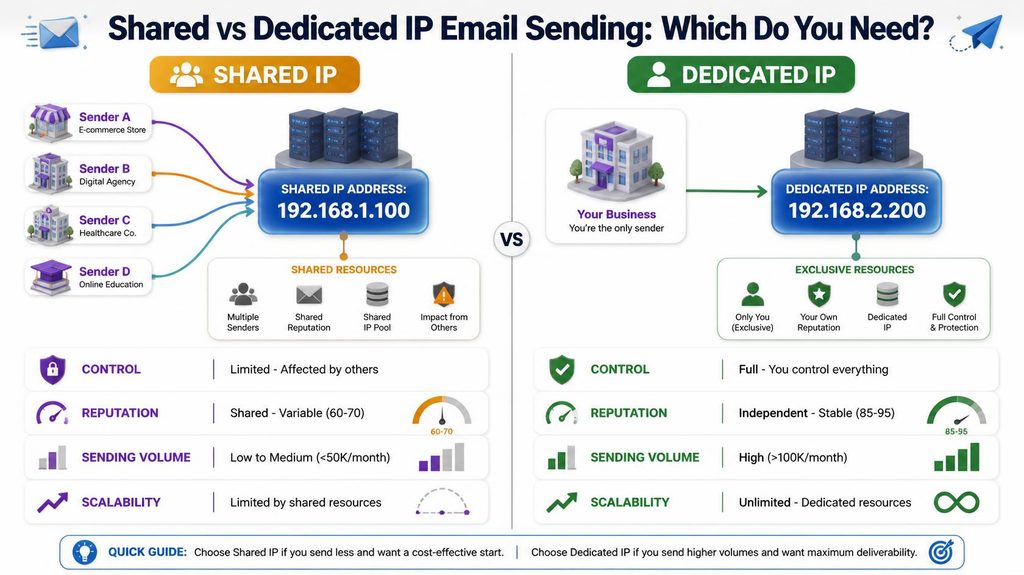
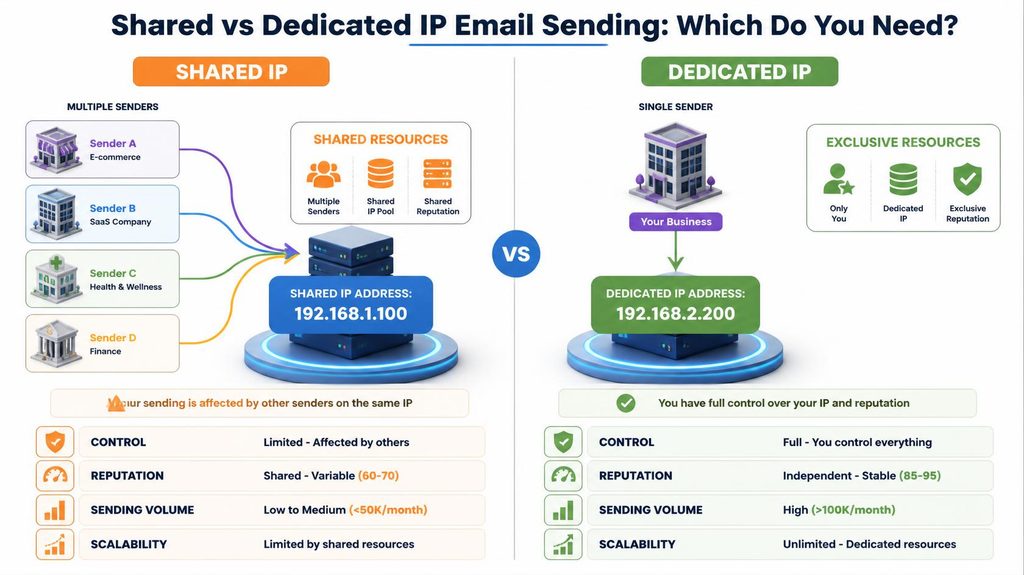
A shared IP is used by many different senders through the same email platform, and its reputation reflects the combined behavior of everyone sending from it. A dedicated IP is used only by you, which means your reputation on it is entirely your own, for better or worse. See how domain and IP reputation actually differ for the fuller picture behind why this distinction matters.
Why this decision trips people up
A dedicated IP sounds like the more serious, more professional option, and platforms sometimes market it that way, as an upgrade for teams that are “ready” for it. That framing leads plenty of smaller senders to buy one before they actually have the volume to support it, then wonder why deliverability is worse than it was on the shared IP they left behind. The honest reality is that a dedicated IP is a tool suited to a specific situation, high, consistent volume, not a universal upgrade that’s automatically better once you can afford it. Buying one too early is one of the more common, avoidable deliverability mistakes among growing senders.
The case for a shared IP
- Established reputation from day one. A well-run shared IP pool already has sending history and trust built up, which a brand new dedicated IP simply doesn’t have yet.
- No warm-up burden on you. The platform manages the shared IP’s reputation across many senders, spreading the responsibility rather than putting it entirely on your shoulders.
- Lower cost. Dedicated IPs are typically a paid add-on on top of your regular platform subscription.
- Safer at low or inconsistent volume. An IP that isn’t sending enough regular volume to maintain a reputation can actually look suspicious to mailbox providers, a problem shared IPs don’t have since combined volume across many senders keeps it consistently active.
The case for a dedicated IP
- Full control over your own reputation. Nobody else’s bad sending behavior can drag your deliverability down.
- Predictability at scale. At high, consistent volume, your own sending patterns become the only variable, which makes performance easier to diagnose when something goes wrong.
- Useful for highly regulated or sensitive sending. Some industries or use cases benefit from being able to point to an isolated sending history that’s entirely their own.
What volume actually justifies one?
There’s no official cutoff, but a commonly cited rough guideline is somewhere around 100,000 to 250,000 emails a month sent consistently, not just occasionally. Below that, most senders don’t generate enough steady volume to build and maintain a strong independent reputation, and a dedicated IP sitting mostly idle between sends can actually look worse to mailbox providers than steady shared-IP volume.
Do you still need to warm up a dedicated IP?
Yes, and this is easy to underestimate. A brand new dedicated IP has exactly as much sending history as a brand new domain: none. It needs the same kind of gradual, careful ramp-up described in warming up a new sending domain, and skipping that step defeats much of the point of having a dedicated IP in the first place.
Can a dedicated IP actually hurt you?
Yes, if it’s not sending enough consistent volume, or if you make a sending mistake, like an unchecked list or a sudden volume spike, that gets attributed entirely to you with no other senders’ good behavior to offset it. On a shared IP, one sender’s mistake gets diluted across many senders’ combined history. On a dedicated IP, every mistake is fully and directly yours.
What a real decision looks like in practice
| Your situation | Better fit |
| Sending under 50,000 emails a month | Shared IP |
| 50,000-100,000 a month, growing steadily | Shared IP, revisit in a few months |
| 100,000-250,000+ a month, consistent every month | Dedicated IP worth considering |
| High volume but seasonal or irregular | Shared IP, despite the volume |
| Sending highly regulated or sensitive content (finance, healthcare, legal) | Dedicated IP, for isolation, even below the volume threshold |
What it actually costs to switch
Most major email platforms price a dedicated IP as a monthly add-on on top of your existing plan rather than bundling it in by default, and the exact cost varies enough by platform and contract tier that it’s worth checking directly with your provider rather than assuming a figure. Beyond the direct cost, factor in the time cost of warming it up properly, several weeks where you can’t yet rely on it for full-volume sending, before it delivers the benefit you’re paying for.
Is a shared IP ever the objectively better choice, even at high volume?
Sometimes, yes, particularly if your volume is high but inconsistent, heavy sending some months and quiet in others. A dedicated IP rewards steady, predictable volume. Irregular sending patterns can actually perform better on a shared IP, where the platform’s overall consistent activity smooths over your own gaps. Seasonal businesses, event-driven sending, and anything tied to an irregular calendar are worth thinking through carefully before committing to dedicated infrastructure that assumes a steady rhythm you may not actually have.
Signs you might actually be ready for a dedicated IP
- You’re consistently sending well over 100,000 emails a month, not just occasionally spiking to that level
- Your volume is predictable enough that you won’t have long stretches of near-silence between sends
- You’ve already got clean list practices and low bounce and complaint rates on your current shared IP, since a dedicated IP amplifies existing habits, good or bad
- You have the patience for another multi-week warm-up period before the switch pays off
- You’re troubleshooting a specific, ongoing shared-IP reputation issue caused by other senders that a platform migration hasn’t resolved
If most of these don’t currently apply to you, that’s a reasonable sign to stay on a shared IP for now and revisit the question again once your sending has grown or stabilized further.
Can you use more than one dedicated IP?
Yes, and larger senders sometimes do, splitting different types of mail, marketing, transactional, cold outreach, across separate dedicated IPs specifically so a problem with one type of sending doesn’t affect the others. This is generally only worth the added complexity at meaningfully higher volume than the threshold for a single dedicated IP, since each one needs its own warm-up and ongoing healthy volume to justify existing separately.
What happens if you outgrow your shared IP mid-campaign
Growth is rarely a clean, predictable line, and it’s common for a sender to cross the volume threshold where a dedicated IP starts making sense right in the middle of an active, important campaign season. Resist the urge to switch infrastructure at the busiest possible moment. A dedicated IP needs its own warm-up period before it’s reliable, and starting that process during your highest-stakes sending window means asking a brand-new, unproven IP to carry your most important mail at exactly the wrong time. The better sequence is finishing the current campaign or season on your existing, proven shared IP, then planning the migration and warm-up for a quieter period afterward, so the new IP is already trustworthy before it needs to carry real weight.
Frequently asked questions
What volume actually justifies a dedicated IP?
A commonly cited rough guideline is around 100,000 to 250,000 emails a month, sent consistently rather than occasionally. Below that, a shared IP is usually the safer and more cost-effective choice.
Do you still need to warm up a dedicated IP?
Yes. A new dedicated IP has no sending history at all, and needs the same gradual ramp-up as a brand new domain before mailbox providers extend it real trust.
Can a dedicated IP hurt your deliverability?
Yes, particularly if volume is low or inconsistent, or if a sending mistake happens with no other senders’ behavior to dilute it. Every mistake on a dedicated IP is fully your own.
Is a shared IP ever better even at higher volume?
Yes, particularly with irregular sending patterns. A dedicated IP rewards steady, predictable volume, while a shared IP’s combined activity can smooth over gaps in your own sending schedule.
How much does a dedicated IP typically cost?
It’s usually priced as a monthly add-on on top of your regular email platform subscription. The exact amount varies by platform and plan tier, so check directly with your provider rather than assuming a standard price.
Should highly regulated industries use a dedicated IP regardless of volume?
It’s worth considering even below the usual volume threshold, since the value there is isolation and a clean, attributable sending history, not just economics. Finance, healthcare, and legal senders sometimes make this trade-off for that reason.
Where to start
If you’re not confidently sending well over 100,000 emails a month on a consistent schedule, a shared IP is very likely the right call for now. Whichever you choose, a clean, checked list matters more to your reputation than which type of IP is carrying it.
