

The Short Answer
If you only need to clean an email list, both ZeroBounce and NeverBounce will do the core job. Both verify addresses in bulk and in real time, and both sell credits and subscriptions. The real difference is breadth against focus. ZeroBounce presents itself as a full deliverability platform, with verification at the center and a wide set of extra tools around it. NeverBounce keeps its focus tighter on verification itself, plus automated syncing that keeps a list clean without repeated manual uploads.
That difference decides the pick for most buyers. If you already have deliverability tools and only want clean lists, the narrower tool may be enough. If you want one platform that also covers warmup, inbox placement testing, and domain monitoring, the broader suite is worth a closer look. This guide compares what each vendor publicly offers across four areas: verification checks, data extras, integrations, and credit model. For current prices, check each vendor’s own pricing page, because prices and plan details change over time.
What ZeroBounce Does
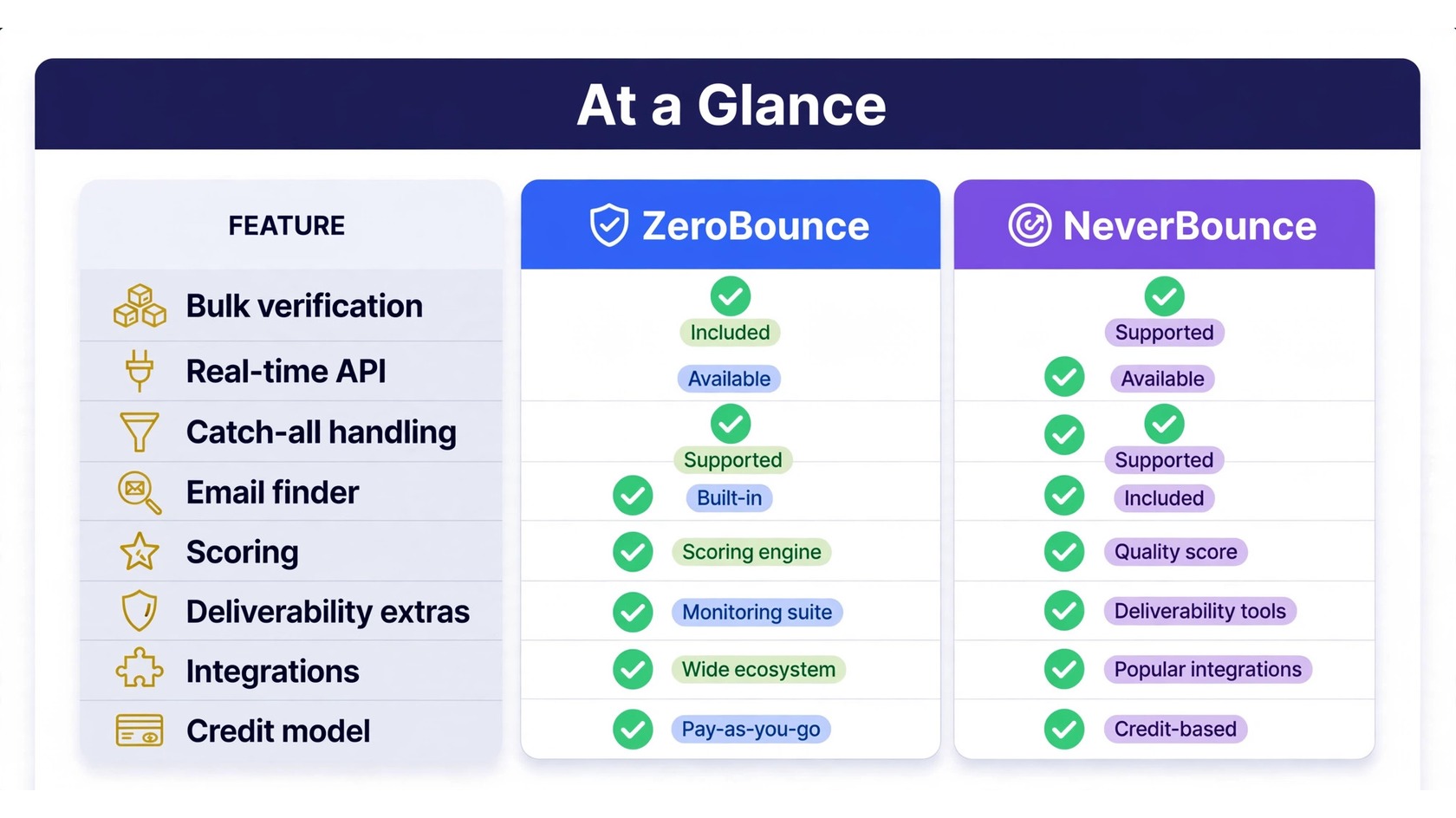
ZeroBounce describes its service as email validation plus deliverability tools. The core is list cleaning: it checks addresses in bulk uploads and in real time through an API. Its public pages say it detects invalid, disposable, and inactive addresses, and identifies spam traps, abuse emails, and catch-all addresses. It also states that its catch-all validation covers addresses protected by secure email gateways, which are setups that accept mail for a whole domain and can make single-address checks harder.
Around that core, ZeroBounce lists a long set of extra tools. Activity Data shows engagement signals for contacts. AI scoring ranks catch-all and uncertain addresses so you can decide which ones to keep. Email Finder looks for professional addresses from a name and company domain. Email Warmup builds sending reputation for new or inactive domains. Inbox Placement Testing previews where mail lands across providers. Email Server Testing checks authentication and DNS records. Blacklist Monitoring watches for listings, DMARC Monitor watches for spoofing, and a deliverability dashboard brings the signals together. If you want the alternative angle on this vendor, see our guide to ZeroBounce alternatives.
What NeverBounce Does
NeverBounce presents three solutions with one goal: clean lists that reach the inbox. The first is bulk list cleaning. You upload a list of any size and download a cleaned version. The second is real-time verification at the point of entry, so addresses get checked on lead pages, registration forms, newsletter signups, point-of-sale terminals, and inside CRMs and content systems. The third is automated list cleaning through Sync, which connects your CRM or email provider and keeps lists clean on an ongoing basis instead of waiting for the next manual upload.
Its extras stay close to verification. Instant Bounce Analysis gives a quick read on whether a list is ready to send or needs cleaning. New users get free credits on signup for testing single emails, bulk lists, or the API. Its pay-as-you-go cleaning includes automatic typo fixing and pulls the company name from each email. Its Growth plan adds AI scoring, AI-picked leads matched to your best customers, and auto-sync that charges only for new, unique emails. For the alternative view on this vendor, see our guide to NeverBounce alternatives.
Verification Checks: What Each One Screens For
Both tools cover the standard job of separating sendable addresses from risky ones, but their public pages describe the checks in different levels of detail. ZeroBounce spells out the categories it screens for, including invalid, disposable, and inactive addresses, plus spam traps, abuse emails, and catch-all addresses. It also offers scoring for the uncertain cases, which helps when a result is not a clean valid or invalid answer.
NeverBounce describes its verification more by workflow than by category list: bulk cleaning, real-time checks at signup, and continuous Sync cleaning. Its stated extras include typo fixing, which corrects common domain mistakes, and company-name enrichment from each address. One practical difference to check before you buy is how each tool labels catch-all addresses in its results, and whether your workflow treats those labels as keep, review, or drop. Catch-all domains accept mail for any address, so a basic check cannot confirm the specific mailbox exists. ZeroBounce states that it validates catch-all addresses and scores them. For NeverBounce, review its result labels and documentation for catch-all handling before you mail that segment.
Data Extras Beyond Basic Verification
This is where the two tools diverge the most. ZeroBounce’s public pages list a broad deliverability suite beyond verification: activity data, AI scoring, an email finder, domain search, warmup, inbox placement testing, server testing, blacklist monitoring, DMARC monitoring, and a deliverability dashboard. If you manage deliverability for clients or for a large sending program, that breadth can replace several separate tools.
NeverBounce keeps its extras closer to the verification job. Sync automation is the headline extra, because it removes the need for repeated manual cleaning. Instant Bounce Analysis gives a fast pre-send check. Typo fixing and company-name enrichment add small data-quality wins on every verification. The Growth plan adds AI scoring and AI-picked leads, plus auto-sync that only charges for new, unique emails. The practical question is whether you need a deliverability suite or a verification engine. If you already run separate tools for warmup, placement testing, and monitoring, the broader suite adds less value. If you want one login to cover more of the job, breadth matters.
Integrations: Plugging Into Your Stack
Both tools connect to the platforms senders already use, and both offer an API for real-time verification. ZeroBounce says it offers more than 40 integrations, including HubSpot, Salesforce, Klaviyo, Zapier, and WordPress, and it supports real-time verification as visitors submit their information. NeverBounce says it offers more than 80 integrations, including Zapier, HubSpot, and Mailchimp, and its Sync feature connects your CRM or email provider for continuous cleaning.
Do not pick based on integration counts alone. Check whether your specific platform is on each vendor’s list, and whether the connection is native or runs through Zapier. Also check what the integration actually does. A real-time form integration that blocks bad signups at entry saves more cleaning work than a bulk-only connection that requires manual uploads. If your stack includes a CRM, confirm whether the vendor supports automatic syncing with it, since that is the feature that keeps lists clean between campaigns without manual effort.
How to Choose: A Simple Decision Guide
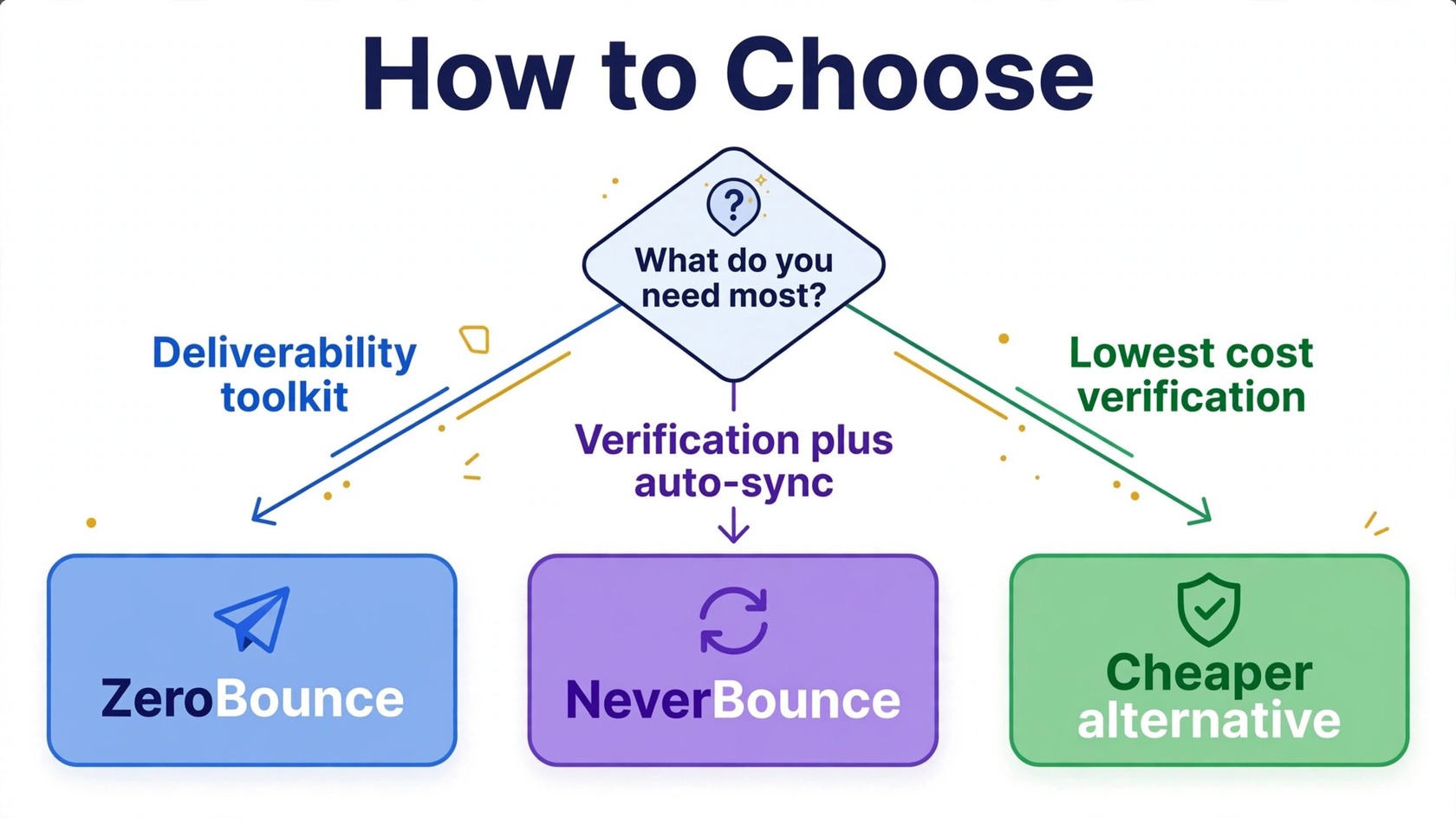
Four questions settle this comparison for most buyers. First, do you need deliverability extras beyond verification, such as warmup, inbox placement testing, or DMARC monitoring? If yes, ZeroBounce’s broader suite is the stronger fit. Second, is your need a one-time cleanup or ongoing list hygiene? If ongoing, NeverBounce’s Sync automation is built for that pattern, and ZeroBounce’s subscription also covers repeat verification. Third, where do bad addresses enter your system? If bad signups are the problem, real-time API verification matters more than any bulk feature. Fourth, what does your stack use? Confirm native support for your email platform and CRM before you commit.
Choose ZeroBounce if you want verification plus a wide deliverability toolkit in one platform, including scoring, a finder, warmup, and monitoring. Choose NeverBounce if you want verification with automated syncing and a tighter feature set, and you already have or do not need the extra deliverability tools. Choose a cheaper alternative if price is the deciding factor and you only need solid verification without the extras. The next two sections cover the credit model and the cheaper option.
Credit Model and Pricing Structure
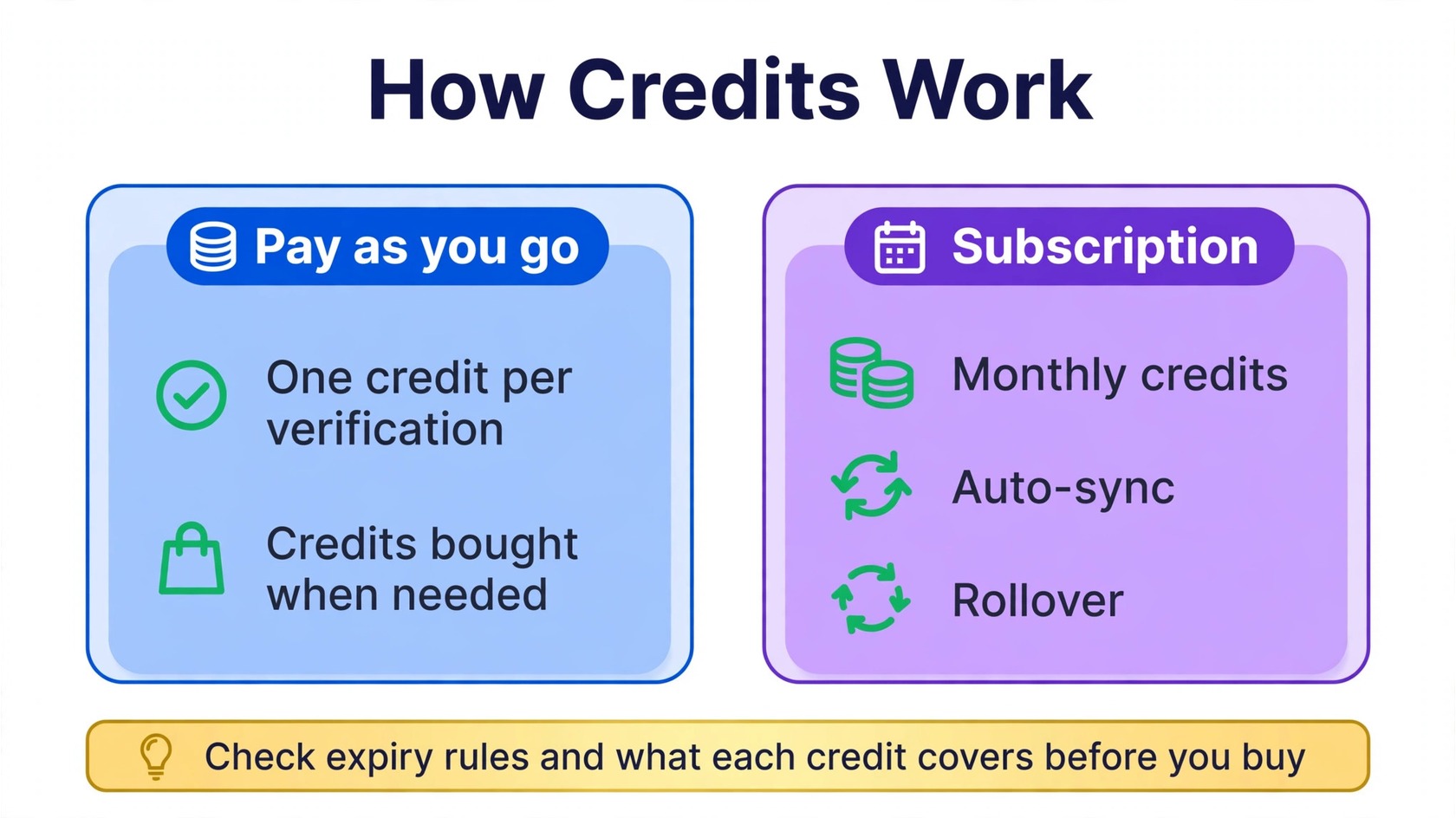
Both vendors sell credits, and both offer pay-as-you-go and subscription options. The details differ in ways that affect what a credit actually buys. ZeroBounce states that one credit covers one email verification, whether you use bulk validation or the real-time API, and that scoring an address costs an additional credit. Its Email Finder costs more credits per successful query than a single verification. It also states that it does not charge credits for unknown results or for removing duplicate addresses, and that credits never expire while you hold an active subscription, with expiry rules possibly applying otherwise.
NeverBounce’s pay-as-you-go option sells credits that carry an expiry window stated on its pricing page, so check that window before buying a large block you will not use quickly. Its Growth subscription adds auto-sync with your CRM, and it states that you only pay for new, unique emails, with duplicates free. Its Enterprise tier is custom-priced for larger volumes and complex stacks. When you compare the two, do not compare headline prices alone. Match what each credit covers, whether scoring and finder queries cost extra, whether duplicates and unknown results are charged, and whether credits expire. For the exact current figures, see ZeroBounce’s pricing page and NeverBounce’s pricing page. For a broader look at how verification pricing works, see our guide to email verification pricing.
A Cheaper Alternative Worth a Look
If price is the deciding factor, it is worth comparing both vendors against a verification-focused tool before you commit. PureListVerifier concentrates on email verification: syntax, domain, mail server, and mailbox checks, plus flags for risky categories such as catch-all and disposable addresses. It does not bundle warmup, inbox placement testing, or DMARC monitoring, so it suits buyers who want clean lists without paying for a wider suite.
The trade is straightforward. You give up the extra deliverability tools, and you gain a simpler product at a lower cost. If you only verify lists before campaigns and keep signups clean at entry, that trade usually works in your favor. Review the features page to confirm the checks covered, and check pricing to compare plans. For a wider price comparison across the market, see our guide to the cheapest email verification tools.
Frequently Asked Questions
Which is better, ZeroBounce or NeverBounce?
It depends on what you need. ZeroBounce fits buyers who want verification plus a broad deliverability toolkit, including scoring, a finder, warmup, inbox placement testing, and monitoring. NeverBounce fits buyers who want verification with automated syncing and a tighter feature set. For basic list cleaning, both cover the core job, so choose on extras, integrations, and credit model rather than on the brand name.
Is there a cheaper alternative to ZeroBounce and NeverBounce?
Yes. Verification-focused tools such as PureListVerifier cover the core checks without bundling the wider deliverability suite, which keeps the price lower. Compare the checks covered and the credit rules before you decide, and see pricing for current plans.
Do they offer free trials?
Both offer a free way to try the service. ZeroBounce offers a freemium tier with a monthly allowance of validation credits plus limited access to some extra tools. NeverBounce offers free credits on signup and states that no credit card is required to verify your first list. Check each vendor’s current offer on its own site, since free allowances change over time.
Which one integrates with my email platform?
Both cover the major platforms, and both offer an API plus Zapier-style connections. ZeroBounce lists more than 40 integrations, and NeverBounce lists more than 80. Counts alone do not settle it. Check each vendor’s integration list for your exact platform, and confirm whether the connection supports real-time verification, bulk cleaning, or automatic syncing.
How accurate are they?
No independent test is cited here, and you should treat any vendor accuracy figure as a marketing claim rather than a measured result. Real accuracy depends on your list: the share of catch-all domains, how old the addresses are, and how many come from disposable or role-based sources. The safest check is to run a sample of your own list through each tool and compare the results against your actual bounce data before you commit to a large credit purchase.
